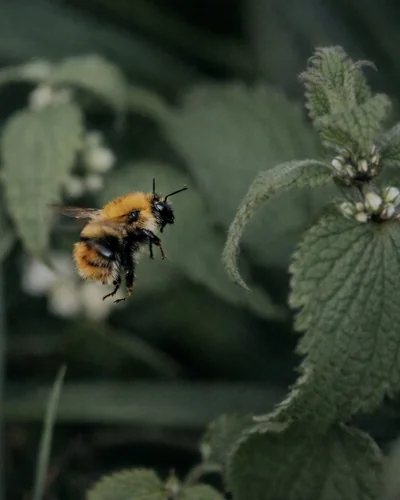
There's a plant growing in the verge outside your house right now. It looks like a stinging nettle — same leaf shape, same rough texture, same unpromising presence in the hedgerow — and most people give it the same wide berth. They're wrong to. Stand over it on a warm April afternoon and watch what happens. Sooner or later, a bee will arrive, push its whole head inside one of the flowers, and go completely still. Not resting. Working. The white dead nettle has been waiting for this.
A name that does it no favours
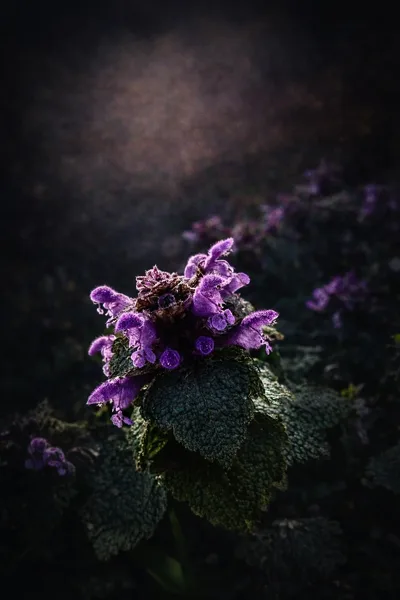
White dead nettle — Lamium album — shares its genus with the red dead nettle, the scrappy purple-flowered plant of early spring. Both are members of the mint family rather than the nettle family, both are entirely sting-free, and both have been dismissed as weeds by gardeners who didn't look closely enough. But where the red dead nettle is compact and low and flowers in February, the white version is taller, tougher, and goes on for most of the year — April through to October in a mild season, sometimes later. It is the more robust of the two, the one you'll find colonising whole stretches of bank, the one that comes back without encouragement, season after season, from the same roots.
The Romans knew it as album — white — for the obvious reason, though the flowers are more complex than that word suggests. Up close, each bloom is a small hooded tube, the upper lip arching forward like a visor, the lower lip broad and spotted with faint greenish markings. There is an exact geometry to it: the hood protects the nectar from rain, and the proportions are calibrated almost perfectly to the bumblebee that visits it. They fit together. The bee pushes in and triggers the anthers; the pollen falls on the bee's back; the bee carries it on. The plant has been doing this for thousands of years in the hedgerows and rough margins of Britain, unnoticed, unhurried, entirely confident in its arrangement with the bees.
What it actually does
The white dead nettle's real significance is its season. Most of the showier spring plants — the cherry blossom, the bluebells, the daffodils — are brief. They come, they're extraordinary, they go. The white dead nettle simply keeps going. Through the gap after the spring flush and before the summer wildflowers properly establish, it is in the hedgerows providing nectar. It is there for the bumblebee queens building their early colonies. It is there for the worker bees through May and June. It is there, still, in September, when the season is thinning out and the choices are narrowing. The plant that nobody notices is the one that holds things together.
The plant that nobody notices is the one that holds things together.
It has other uses that have accumulated over centuries. Medieval herbalists prescribed it for "fluxes of blood" — the leaves will staunch a minor wound. Young leaves are edible, with something of the spinach about them, and have been eaten since at least the Middle Ages. Country names for it include archangel — one of the more generous things ever bestowed on a roadside plant — and bee nettle, which at least acknowledges the relationship that matters most. In some parts of Britain it was once called deaf nettle, which is a kinder version of "dead": harmless, not dangerous, just not a stinging nettle. It has been getting on with things, quietly, in the margins of British life for a very long time.
What it looks like, close up
Stand back and it's an undistinguished green column. Move in close, when the light is low and coming from the side, and the whole thing opens up. The leaves, heavily wrinkled and pale-veined, catch the light differently from every angle — they have a texture like old linen, each surface a small landscape of ridges and hollows. The flower clusters sit in whorls around the stem, white against green, and in good light the petals seem almost to glow with their own warmth. Each flower has a dark interior that draws the eye inward. The bee knows this too, of course. That darkness is the promise of something worth having.
Even the spent flowers have their quality. The dried calyces — the small cups that held each bloom — are intricate and papery, standing long after the flower has dropped, turning a warm amber in the autumn light. A plant that gives something at every stage of the season, including the end of it.
Where to find one
Wherever the ground is rough and no one has been too tidy. Hedgerow bases, road verges, the unmown strip at the edge of a field, the scrubby margins of paths and walls. It likes disturbed ground and doesn't mind shade. Often it shares a bank with the lesser celandine — two of the quiet ones, working the same patch in the same hours of light. It won't be difficult. Once you start looking for it you will wonder how you didn't see it before, because it's been there all along — in the verge, at the edge of the car park, at the bottom of the garden where the mower doesn't reach. Growing quietly. Feeding things. Getting on with it.
Stop next to one on a warm afternoon and wait. The bee will come. Watch it push its head in and go still for a moment, entirely absorbed. That's what all those centuries of quiet, unnoticed engineering have been working towards — a small white flower in a hedgerow, and something alive inside it, taking exactly what it needs.