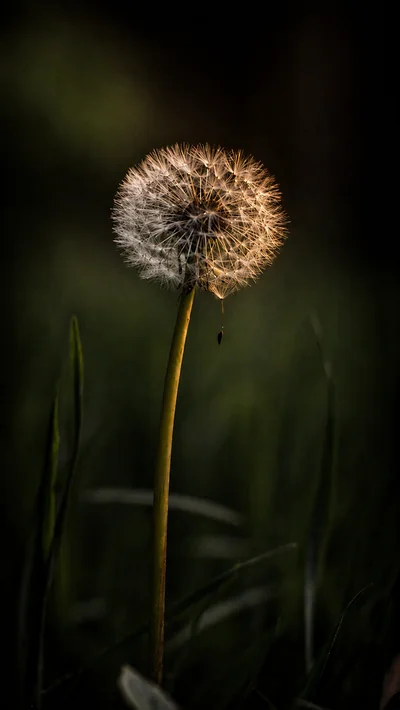
It is a sphere, and it shouldn't be. Nothing in the natural world is required to be a sphere, and very few things bother. A water droplet, briefly. A planet, given enough time and gravity. The yolk of an egg before it hits the pan. And then this — a hundred-odd seeds held in mid-air on the end of a stem, each on its own filament parachute, arranged with such consistency that the whole structure looks turned on a lathe. The dandelion did this with no machine and no instruction. It does it in the corner of every lawn in Britain, in early April, while no-one is looking.
A hundred parachutes, one balance
The white globe of an open dandelion clock is roughly four centimetres across. Inside that small volume there are typically between eighty and one hundred and seventy seeds, depending on the plant. Each one is mounted on a slender stalk and topped with a bristled crown of fine white filaments — the pappus — which fans out into something that looks, to the eye, exactly like a parachute, and which behaves, in the air, like nothing else on earth.
For a long time the assumption was that the pappus worked the way a parachute works: by trapping air underneath itself, dragging it along, slowing the seed's fall. It seemed obvious. It is also, as it turns out, wrong. In 2018 a team at the University of Edinburgh put dandelion seeds into a wind tunnel and watched what the air actually did when it met them. What they found was a structure no-one had described before: a perfectly stable ring of low-pressure air, held in place a few millimetres above the bristles, separated from the pappus itself but locked to it as if invisibly tethered. They called it a separated vortex ring. It is, as far as anyone knows, unique to the dandelion. Four times more efficient than a solid disc of the same size. The plant solved a problem in fluid dynamics that human engineers had not yet thought to ask.
"The dandelion is, among other things, the most quietly accomplished aerospace engineer in the British countryside."
The geometry of stillness
None of this engineering matters until the wind comes. Until then — and this is what the photograph is about — the seed head is simply standing there, perfect and motionless, in the only condition where you can really see it. The slightest breeze and the geometry blurs. A passing dog, a sneeze at six paces, and half the structure is gone. To photograph an open dandelion clock at the moment of its full and undisturbed sphere is to catch a thing that is, by its own nature, almost never still and almost never seen.
Look closely and the sphere is not actually a sphere. It's a very slightly flattened polyhedron, the seeds packed on the receptacle below in a pattern that follows, as so many flower geometries do, the Fibonacci series — the same arithmetic of growth that orders the spirals of a sunflower or the scales of a pine cone. Each seed sits at a precise angle to its neighbours, calculated so that no two parachutes shadow one another from the wind. Every seed gets a fair share of the next gust. The plant is not generous; the plant is exact.
Two clocks
There is something else in the frame. A few inches from the dandelion, half-hidden in the grass, a piece of litter. It doesn't matter much what it is — a cigarette filter, a fragment of crisp packet, a torn-off corner of something with a barcode on it. The point is that it is there, and that it is not going anywhere. The dandelion will be gone by the weekend. The litter will outlive the photograph, the photographer, the website the photograph is hosted on, and very probably the children of anyone reading this. A polyethylene fragment has a working lifetime, in a British hedgerow, of somewhere between four and five hundred years. The dandelion's working lifetime, from open globe to bare receptacle, is about three days.
So there are two clocks in this picture. One of them is the dandelion, counting itself down with great elegance: each seed leaving on its own vortex, each filament doing its calculated work, the whole structure designed to disappear at exactly the right speed. The other clock is the piece of plastic, which is also counting — but counting in the other direction, against us, with no comparable elegance and no scheduled end.
I'm not going to lecture about this. The plant doesn't need me to. The frame already contains the entire argument: the thing nature made, which lasts three days and is a small miracle of engineering, sitting next to the thing we made, which lasts five centuries and is a small piece of rubbish. Whichever way round you look at it, one of these objects is more dignified than the other, and it is not the one with the brand name on it.
The pause before the leaving
What I find difficult to stop looking at is the held quality of the thing. The bracts have curled fully back. The receptacle below — bare, slightly domed — has presented its hundred passengers to the air and is now waiting. Nothing about the dandelion's life so far has been still: it grew, it flowered, it folded itself shut, it opened again. And now, briefly, it is doing nothing. It is in the suspended moment before the long dispersal — the pause that any photographer recognises, because it is the same pause we recognise in a swimmer at the end of the high board, in a crowd before the first applause, in the second between the conductor's raised baton and the first note of the symphony.
The British countryside is full of these pauses, if you know to look for them. The held breath of a heron before it strikes. The motionless minute of a fox at the edge of a wood, deciding. The instant a hawthorn flower opens. The dandelion, for all its commonness, has the same quality. It is doing one of the most extraordinary things in the plant world — it has built a launch platform for a hundred miniature aircraft and is about to release them — and it is doing it in front of you, in your garden, on a Wednesday afternoon, with no fanfare at all.
That is the photograph. Not the clock that everyone has seen and blown on as a child. The clock you have stopped to look at — properly — for the first time. The one that turns out, on inspection, to be one of the most quietly remarkable objects in the British spring. The next post in this series will follow what happens after the wind arrives. For now, the globe is almost whole — a seed or two already gone from the crown, the rest still held — the air is quiet, and the plant is waiting. So am I.
If you missed the post before this one, it is here: the dandelion clock before it opens — the closed, ribbed stage that comes between flower and globe.