"What is that?!"
It is the typical exclamation, because this flower is very different from what one would typically see in a fallow field. It takes you aback. It gives you pause. It glows in the low sun like some firefly ablaze, lighting the flowers around it. Bright. Properly red. Not the muted purple-pink of red clover, not the pale white-and-cream of its more common cousin. Crimson. The colour after which it was named.
This is Trifolium incarnatum. The crimson clover. And it is doing more in that field, quietly, than almost anything else flowering in April.
What stops you
You notice the first one. Lit up like a red flame. As you near it, you realise that it just happened to be painted by the spring sun at exactly the angle that lights it up. Others surround it, but have not had the pleasure of the light hitting them directly. You think this cone is unique until you step into the field and realise that they are numerous. They are all around you. They are drilled. Just one arrow in the farmer's quiver.
The flower head is conical — long, tapered, like a small cylindrical lantern packed densely with hundreds of tiny crimson florets. Each individual floret is small, but the head as a whole is substantial, often two or three inches long, and the colour is uniform from base to tip. They wave in the wind in great drifts, hundreds of them in a field, and from a distance the whole patch looks like it is on fire.
Up close, the leaves are the giveaway. Three-leafed, the same trifoliate pattern you know from white clover and red clover and every clover the world over — but slightly hairier, slightly softer to the touch. The whole plant is faintly fuzzy, as if it has been dusted with the lightest possible coat of fur. That softness, against the hard brilliance of the flower, is part of what makes it so striking up close.
Where it came from
It is not, strictly, a British plant. It comes from the Mediterranean — Italy, France, Spain, the warmer parts of southern Europe — where it grows wild on rough ground in the same way that dandelions do here. It arrived in Britain centuries ago, brought in deliberately, because it does something useful.
That is the second thing to know about it, and the more important one.
It has a job.
What it does
Like all clovers, it is a legume. Its roots host bacteria that pull nitrogen out of the air and fix it into the soil — quietly, slowly, without anyone telling them to do it. A field of crimson clover left for a season will return to the next crop with the soil meaningfully richer than it was. It enriches what it grows on. It gives back to the ground that holds it.
This is why farmers plant it. It is sown as a cover crop — between the cereal harvests, on the fallow ground, as a green manure that gets turned under before the next planting and feeds whatever comes next. It holds the soil together against winter rain. It suppresses the weeds. It keeps the ground alive.
Virgil wrote about bees and cover crops in the same breath, treating both as sacred. He would have understood this field.
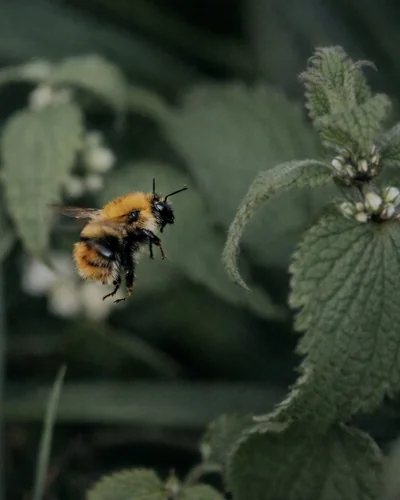
And while it is doing all of that, it is also one of the best bee plants in the British April. Bumble bees with longer tongues love it — it is a good source of nectar at a point in the year when the early spring flowers are fading and the summer ones are not yet here. The queen who survived March will work crimson clover gratefully in April. The first workers, just emerging from their nests, will load up on it through May. Honeybees too, when they can get to it, though its flowers are slightly deep for their shorter tongues.
It feeds the soil. It feeds the bees. It holds the field together.
When and where to find crimson clover in Britain
April through July, in working agricultural landscapes — field margins, cover-cropped fallow, the rough edges where it has escaped a sown crop and naturalised on its own. It likes well-drained soil and full sun. It does not grow in deep shade or in waterlogged ground. Look in the south and east of England for the best chance, though it will turn up further north in the right conditions.
You will know it when you see it, because you will not have seen anything like it yet that year. You will stop. You will say something out loud. And then you will go closer, because that is what it is for — to make you cross a field deliberately, in April, and pay attention to something you did not expect to see.
It is doing its quiet, brilliant work in some farmer's rotation, fixing the soil and feeding the bees and waving its crimson cones in the low afternoon light.
If you find it, stop. Cross the field. Get close enough to see the fuzz on the leaves and the way each tiny floret packs into the head. Then leave it alone. It has work to do.