You see it before you've understood what you're looking at. Come over the ridge of a B-road somewhere in lowland Britain in late April, and the next valley is yellow — not a polite, buttery yellow, but a saturated, insistent yellow that at a glance looks as if somebody has spilled something across the fields. It takes a second to resolve into sense. A crop. In flower. Acres of it.
That particular yellow
The colour is not gentle. In full sun it seems to overflow its own edges; on a flat, overcast day it is still somehow louder than anything else within sight. Cadmium is the word most people reach for. Saturated is another. The truth is that for most of the year, nothing in the British countryside comes anywhere near this intense — and then, for a fortnight or so, an entire landscape does.
"It is the largest sudden colour event in the country's calendar."
Drive with the windows open and you also get the scent — heavy, mustardy, slightly honeyed, the kind of smell that settles at the back of the throat after a mile. It is not universally beloved. But it is unmistakable, and it only belongs to these two weeks.
What it actually is
The flower is Brassica napus. A member of the cabbage family, cousin to mustard and turnip, bred for the oil pressed from its small, dark seeds. The yellow you are looking at is a working crop, not a cultivated view — the flowering stage of Britain's third-largest arable harvest, grown on close to half a million hectares in a good year. The oil ends up in British chip pans, kitchen bottles, and the cold-pressed rapeseed now sitting alongside olive oil on farm-shop shelves.
Post-war Britain grew almost none of it. The crop came into its own in the late 1970s, after European farmers discovered that the two things that had always held it back — a bitter taste and a compound called erucic acid — could be bred out. The result is the plant we now see everywhere, quietly feeding the country and, for a few April weeks, its eyes.
The awkward bit
It isn't universally loved. The pollen travels a long way on still mornings and sets off hay fever in people who don't normally suffer from it. And for years the crop relied on seed treatments — the neonicotinoid family of insecticides — that turned out to be bad news for bees; the European restrictions on those chemicals, when they came, were largely what the rape fields had been doing to pollinators. The picture is better now, though not uncomplicated. A crop that feeds us, feeds the bees, and occasionally makes us sneeze. Rural life, in other words.
The bees, for their part, want it
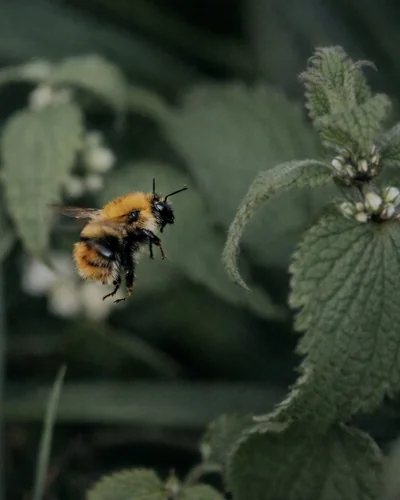
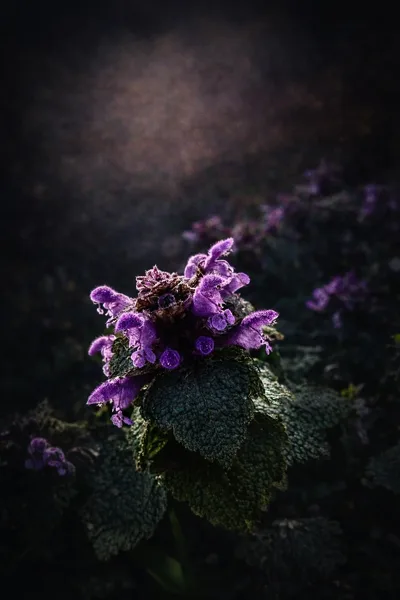
The bees know what to do with it. April in Britain is a thin time for nectar — the first spring blossom is mostly over, the summer flowers haven't started, and a newly-emerged queen trying to establish a colony needs calories urgently. A single field of rape is, to a bumblebee, a stadium's worth of fuel arriving at exactly the right week. Stand at the edge of one in warm sun and the hum is constant — a low, even sound, tens of thousands of insects going about the most important days of their year. The modest red dead nettle does similar work in March, at a quieter scale. The rape simply does it louder.
Where to find one
Anywhere with arable farming. The Thames Valley, the Norfolk and Lincolnshire flatlands, the Yorkshire Wolds, the Cotswold edges, the arable belts of Fife and Aberdeenshire further north — in the last week of April or the first week of May, any drive of any distance through lowland Britain will turn up at least one. The best view is usually from a little height: a hill road, a church tower, the rising edge of a field, where the pattern of yellow and green resolves itself into something close to a Mondrian. Down among the crop the experience is different — a wall of colour at chest height, the scent, the steady sound of the bees.
Either way, it is a two-week thing. Southern fields tend to peak in the last days of April and the first days of May; the Scottish crop runs later, often through May and into June. The peak in any one place lasts ten or twelve days, then fades to seed pods and a quieter green.
Britain does not go in for spectacle often. The weather, the light, the land — they lean towards understatement. And then, for a fortnight every spring, one of our least celebrated crops takes over the view and declines to be modest about it. Whichever road you are driving this next week, if it runs through farmland, there will be one somewhere off to your left or your right. It is worth pulling over for.