The flower that throws the light back
From the correct angle, the whole face of it flares — a hard, wet flash, there and gone as the flower moves, the gleam of light off water or off glass. Plenty of flowers give you yellow. The Welsh poppy gives a soft, diffuse yellow, lit from within. The dandelion gives a stubborn, flat, deep yellow that holds the same from every angle. The buttercup gives a yellow that can only honestly be called specular — a mirror-flash off the petal. It is the reflective trick that has been held under the chin of many a child in Britain. Once the hard grazers — sheep, horses — have cropped the grass down to what their anatomy allows, the buttercup is somehow left standing, bolder than before.
The buttercup — Ranunculus acris, the meadow buttercup — is the flower you knew before you knew its name, filed away in childhood under yellow, common, everywhere. The name means little frog, from the Latin for the damp ground where both it and the frogs are found. Acris means sharp, or acrid, and that is the name to keep, because it does the more interesting work.
The shine, not the yellow
Look at a buttercup head-on in sunlight and it does something the other yellows cannot. It does not glow so much as flash — a hard, almost metallic gleam, as if the petal had been lacquered. A dandelion is yellow. A buttercup is yellow and lit.
That gleam is not pigment, but the yellow is — ordinary carotenoid, the same chemistry as a carrot. And it sits in the very layer that does the flashing. The top of the petal is a single sheet of cells, flat and glass-smooth, with the pigment held inside it and a thin pocket of air trapped just beneath. That flat, pigment-loaded skin behaves like a mirror: light strikes it and comes off the way it comes off water or glass — not scattered in all directions but thrown one way, hard and bright. Beneath the air gap, a deeper layer scatters the softer yellow, the colour you can see from anywhere. So the petal does two things at once. It grants you an audience with the soft yellow, patient, from any side you like — and it flings a sharp flash of it off at a single angle.
The dandelion wears yellow. The buttercup wears yellow and a mirror.
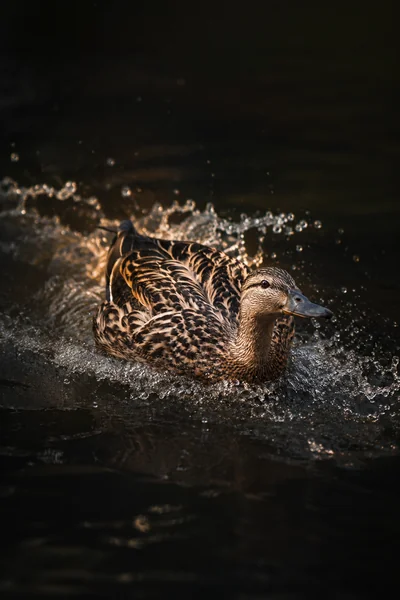
This is the mallard's green seen from the other side. The drake makes his colour out of structure and no pigment at all; the buttercup keeps the pigment and builds the mirror out of the very layer that holds it. Two ways to make a colour — and the buttercup, a flower a child picks with simple joy and admiration, quietly uses both.
Why the chin always says yes
The chin test, then, is real physics, and it has nothing to do with butter. That mirror skin takes the yellow already leaving the petal and throws it, hard and concentrated, onto whatever is held close — and skin, especially the soft pale skin beneath a chin, catches that flung light and shows it plainly. Hold a buttercup to anyone's throat in decent light and it glows. The test detects not so much a fondness for butter as an adorable attempt to qualify the colour. It detects a chin, a working flower, and the sun.
The flower was put to quieter uses, the same as half the meadow: it told a kind of fortune, stood in for gold in a child's hand, meant the field was warm and the afternoon long. None of which it set out to mean. It was busy doing the thing the flash is for — signalling itself to a passing insect, and warming its own centre a degree or two in the doing, a small hot landing-pad on a cold British morning.
The bee that sleeps in it
A flash is an advertisement, and the buttercup is not fussy about who reads it. It holds a shallow gold bowl open to anything passing — hoverflies, beetles, small bees, the bumblebee working the margin — and pays in both currencies at once: loose pollen across the cup, and nectar in a pocket at the base of each petal. To a bee the petal is not even the plain yellow we see. There is a mark on it laid down in ultraviolet, a dark eye at the centre we have no way of seeing, steering the insect down to the nectar across the waiting pollen. The flower is signposted in a colour we were never built to read.
And the poison goes all the way in. The leaf holds it cocked — a stored compound, ranunculin, that flips the moment it is crushed into protoanemonin, the blistering thing that keeps the sheep off — and the same chemistry is laced into the pollen itself, enough, in quantity, to kill the grubs of a bee not equipped for it. The meadow buttercup pitches the dose with some care, just under the level that would do real harm, so the bee can feed and the flower still gets carried. One insect has gone further and taken the whole plant for its own: Chelostoma florisomne, a small black solitary bee whose name means flower-sleeper, lives on buttercup pollen and little else, and has been said to pass the night curled inside a shut buttercup, waiting for the sun to open the door. A creature that eats the poisoned pollen the others cannot, and sleeps in the bowl that fed it.
The field that leaves it standing
Now the second name. Acris. The acridity is no metaphor: it is that same protoanemonin again, full-strength in the leaves now, blistering to any soft mouth, and a grazing animal learns it quickly and for good. The sheep and the horses crop the grass around it to the root and leave the buttercup standing — exactly as the field leaves the oxeye daisy, and for the same reason by a different poison. The buttercup does not win the field by being stronger. It wins by being the one thing in it not worth eating. The poison keeps to the living plant: as the grass dries, the protoanemonin falls apart into harmless anemonin, so a buttercup in the hay does no harm. It is only dangerous green.
Which is why a field run gold with buttercups — more gold than green, the flower not dotting the grass but taking it over — is not quite the postcard it looks. That sheet of gold is usually the mark of hard ground: grazed and poached and trodden, the good grass eaten down, the one plant nothing will touch left to inherit what remains. The meadow buttercup belongs in a good hay meadow too, scattered through the tall grass — so it is the taking over that tells the story, not the flower itself. Where it crowds everything else out, the gold is the look of hunger. The buttercup is loveliest where the grass has had the worst of it.
What's up, buttercup? It was never about the butter.