A drake on the water, close in to the bank, riding the surface as though it were his to ride. Green head, yellow bill, a hard white ring at the throat and the breast below it the colour of old wine. He turns his head, without hurry, and the green of it shifts — darkens, catches, darkens again — and settles. A little behind him, lower in the water and saying nothing, a brown duck keeps pace.
The mallard — Anas platyrhynchos — is the duck you could name before you could read. We meet it at about the age of three, with a bag of bread and a parent pointing, and we file it away under done: green head, yellow bill, the duck on the pond. The bird you can name from forty feet is the bird you have stopped looking at. Which is the whole of the problem — because almost everything worth seeing here is still going on in plain view, starting with that head.
The colour that was never there
Wait for him to turn it again. The drake will swing his head, and the green will come apart in your hands. Bottle green, then a hard teal, then something nearer blue, then, as he dips, a green so dark it folds into black. It does not behave like a colour. It behaves like oil on a wet road, like the back of a beetle, like the skin of a soap bubble the half-second before it goes.
That is because there is no green in that head at all. Not a particle of it. Mallard feathers carry no green pigment, nothing you could grind down and find. The colour is made of microscopic layers inside each feather that take ordinary daylight and reject everything but the green of it, and only from certain angles. Move, and the angle moves, and the colour moves with it. He is not wearing green. He is wearing the conditions under which green appears.
He is not wearing green. He is wearing the conditions under which green appears.
The brown one does the work
There is usually a second bird nearby, and you will have to make yourself look at her, because everything about her is built so that you won't. Brown. Mottled, streaked, the brown of last year's reeds and wet bracken and the underside of a hedge. Beside the drake she reads as the plain one, the afterthought, the female-of-the-species in the most dismissive sense of the phrase.
She is the one that matters. The drake's colour is a flag he can afford to fly; once the eggs are laid, his part is over. She carries the rest. She sits — for four weeks, on a scrape of grass and down at the water's edge, in plain view of everything that would happily eat her. It is not drabness. It is the precise opposite of being seen.
There is a small joke folded into the name, if you go looking for it. Mallard comes down to us from an old French word for the wild drake, and beneath that, faintly, the root that gives us male. The bird is named, at bottom, for the male of it — for the green head and the showing-off — while the brown one beside him, unnamed and unregarded, does the actual work of there being any mallards at all. He gets the postcard. She gets the species through to next spring.
And the loud quack — the one every child does, the one that is the whole idea of a duck — is hers. The drake doesn't make it. He manages a quieter, raspier sort of mutter. The sound you think of as duck is the sound of the bird you weren't looking at.
The vanishing
Some time in the next few weeks, around midsummer, the drake will disappear — and almost no one will notice, because what disappears is not the bird but the bird you recognise. He moults. The green head dulls down to a streaked brown not far off the hen's, the showing-off packs itself away, and for a stretch of high summer he sheds his flight feathers all at once and cannot fly at all. He hides. Quiet and grounded, tucked into the reed margins, doing nothing to draw an eye — which, conveniently, is now the easiest thing in the world.
Eclipse. The word is exactly right. For a few weeks the most familiar duck in the country slips out of its own plumage and waits, flightless, in the green edges of the water, while the people who feed it every Sunday assume the drakes have wandered off somewhere. Then, by autumn, the green comes back, feather by feather, and we greet it as though it had never been away — because we never noticed it leave.
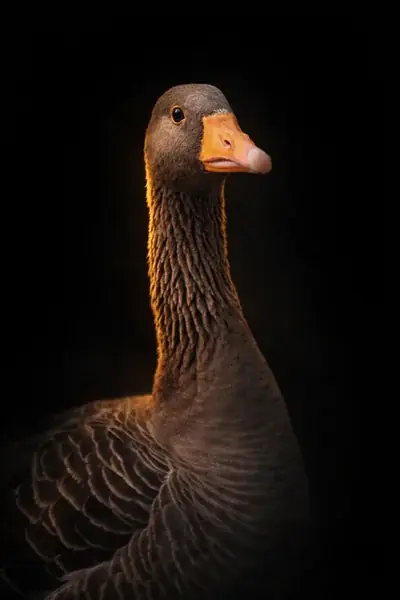
None of this is rare. That is the whole of the point. There is no hide to book, no dawn to lose, no train north. This is the wild original, after all — the bird nearly every farmyard duck came down from, the duck's answer to the grey-lag goose standing behind every farmyard goose. The difference is that the goose still reads as wild, and the mallard has let us forget. There is a pond at the end of most roads in Britain with one on it, doing, with great competence, the only thing he was ever going to do — and most of what is remarkable about him is happening in full view of a park bench, has been happening the whole time, while we were busy being sure there was nothing there to see.
Next time, take the bench. Wait for him to turn his head. Watch the green come apart. It was never there. The country keeps its best tricks not in the far places but in the obvious ones — on the municipal water, under our noses, where they are quite safe.