There are some things you stumble across and just know — before you've even lifted the camera — that this is the shot. This was one of them. A moorhen chick, no more than a few days old, making its way along the waterside grass in Pentrefelin. Tiny. Purposeful. Completely unbothered by the scale of the world it had just arrived in.
The moorhen is one of those birds that tends to get overlooked. It's not as showy as a kingfisher, not as architecturally dramatic as a heron, not as boldly characterful as the grey-lag goose. It goes about its business on almost every pond, canal and slow-moving river in Britain, and most people walk straight past it. But catch one as a chick — all black fluff and that extraordinary tangerine beak, those enormous feet already working like they know what they're doing — and it's impossible not to stop.
"Tiny. Purposeful. Completely unbothered by the scale of the world it had just arrived in."
More interesting than you'd think
The moorhen — Gallinula chloropus, if you want the full name — is not actually a duck, though it's easy to assume. It belongs to the rail family, a group that also includes coots and corncrakes. Unlike ducks, it has no webbed feet; instead those long toes splay out across the surface of floating vegetation, which is exactly why a chick that's barely found its legs can already look like it has some kind of plan.
They're one of the few birds in Britain with two broods a year, sometimes three. The first brood of chicks will often stay around long enough to help raise the next lot — which is either very sweet or rather a lot to ask of a bird that's still learning to walk, depending on how you look at it. Either way, it suggests that the moorhen's reputation for being unremarkable has been somewhat unfair.
A Welsh backdrop worth noticing
Pentrefelin sits quietly in the Welsh countryside, the kind of place that doesn't make a fuss about itself — all reeds and water and that particular grey-green light you only get when the hills are close and the sky can't quite decide. It's exactly the habitat the moorhen seeks out: slow water, dense bankside cover, somewhere to vanish into when it needs to. On the day I was there, the mist was still sitting on the water and the reeds were catching what light there was. Not ideal for photography in any strict technical sense. Ideal for everything else.
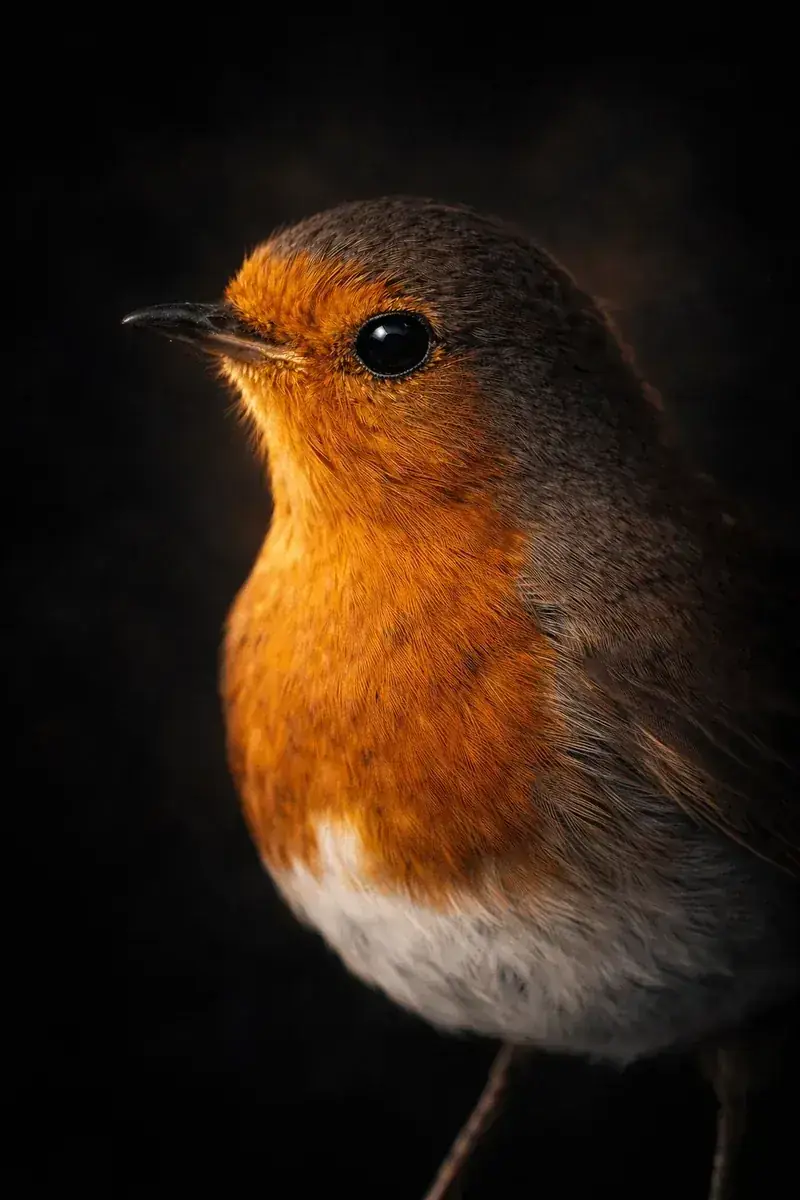
Wales has a habit of doing this — giving you a scene that's moody and atmospheric and a bit difficult, and then placing something extraordinary right in the middle of it. This chick had clearly not read anything about staying hidden — about as shy as a robin on a garden fork.
The first days
Moorhen chicks are what's called precocial — born with their eyes open, covered in down, and able to leave the nest within hours. Hours. They'll still return to be brooded and fed, but the impulse to move, to explore, to pick at things along the waterline, is there almost immediately. Watch one for any length of time and you get the sense it's operating on a very tight schedule. There's a lot of world to cover and it's already behind.
The down is a deep, almost impossible black — the kind that absorbs light rather than reflecting it — with that vivid orange-red bill that looks almost too bright to be real. It serves a purpose: the colours inside the chick's gape mimic spots that stimulate the parents to feed. Nature being practical and beautiful at the same time, as it tends to be. If you want more of this — the small, overlooked, quietly extraordinary — the grey-lag goose is waiting at the water's edge.