An essay — June 2026
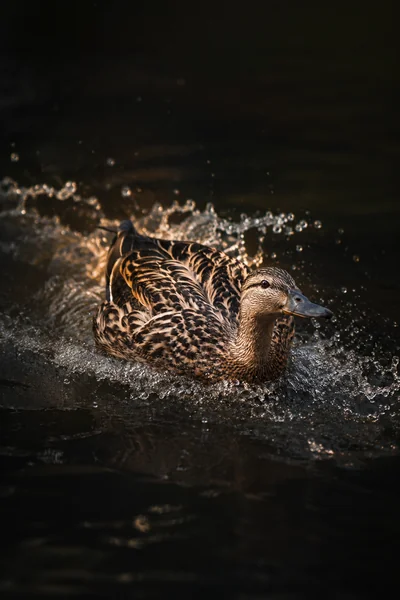
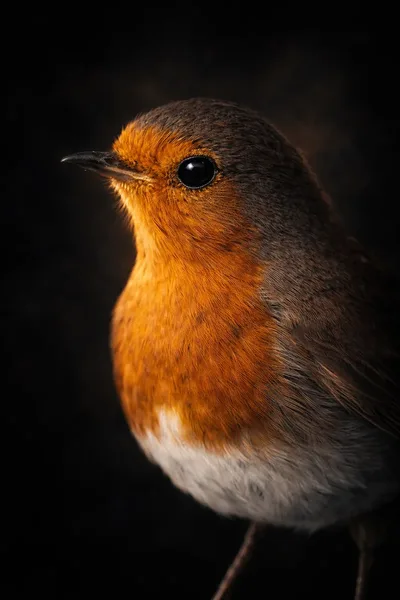
A robin on the spade handle, and a drake on the water twenty yards off, and the same flat grey afternoon laid over both of them. The robin hops along the wood, turns, hops back — and the red on its chest does not move. It holds the same deep red whichever way the bird faces, steady as something painted on. The drake swings his head to watch you and the green of it dies. Goes black. He turns again and it relights, hard and metallic, then gone, then back. Two birds a child could name. Two colours, made two completely different ways — and once you know which is which, the country stops looking quite the same.
Most colour in the living world is one of two things. Pigment, or structure. Chemistry, or architecture. Once you can tell them apart, you can't stop.
The colour a bird carries
The robin's red is pigment. Not light arranged by hidden architecture, not a flash that depends on your angle, but colour lodged in the feather itself. A pigment molecule takes the daylight falling on it, swallows much of it, and hands back the part we read as red. The bird turns, the light shifts, the afternoon stays grey, and still the breast remains itself. The colour is not waiting for you to stand in the right place. It is already there.
That does not make it simple. A robin's breast is a signal as much as a colour — a badge shown to other robins, read in quarrels, in territory, in age and sex and the hard grammar of being noticed by your own kind. But it does not flare and vanish with the angle. It holds because it is substance. The robin owns its red outright. The colour is part of the bird.
The other great pigment is the one nobody thinks to call a colour at all. Melanin — the black of a crow, the brown of a hen mallard tucked into the reeds, the soot on a gull's wingtips. A bird makes its own melanin, which makes it cheap, and it sets hard, which is why so many otherwise white birds carry black at the very tips of their wings, where the feather takes the most wear. Hold the crow there. It comes back.
The colour that was never there
The drake's green is made of nothing. There is no green in him — not a grain of green pigment anywhere in that head. The colour is built out of shape alone: ranks of microscopic layers inside each feather, spaced on the scale of visible light, throwing the green back at you and quietly cancelling the rest. Let the angle change — your head, or his — and the spacing meets the light differently, and the green slides to teal, to blue, to a black that swallows it whole. He is not carrying a colour. He is carrying the conditions a colour needs, and waiting on the light to supply the rest.
The robin owns its red. The drake only borrows his green — by the second, on loan from whatever light is going.
The layers that build that green are packed with melanin. The same flat black pigment that makes a crow plain. As ordinary pigment, melanin is one of the dullest things a feather can hold; stacked into ordered ranks, the same material stops behaving like pigment and starts behaving like a mirror. The crow and the starling begin with the same black. One wears it as matte black. The other, in a starling's winter coat, wears it as an oil-slick of green and bronze and violet thrown across a bird half the country has written off as a nuisance. Same substance. A question of order, and nothing else.
The blue that holds still
Then there is the kingfisher, which exists to ruin the neatness of all this. The blue running down its back is structure too, not pigment. Almost nothing alive makes a blue pigment, and the blue you think you are seeing is nearly always a trick of architecture. But the kingfisher's blue does not flit and gutter the way the drake's green does. It holds. Blue from almost wherever you stand. The difference is in the build: not the drake's neat parade-ground layers, which only line up to fire from certain angles, but a fine, disordered sponge of a structure that scatters blue back evenly in every direction at once.
Which leaves three colours and a small, pleasing confusion. The robin's red and the kingfisher's blue both hold still; the drake's green will not — and yet the red is chemistry while the blue and the green are both nothing but shape. The obvious grouping is the wrong one. How a colour behaves tells you less than you think about how it was made.
The colour with a message
Some colour was never meant to be admired at all. The orange on the male orange-tip's wing — one of the brightest pigments going in an English April — is pigment again, but pigment put to work. It is a notice. The caterpillar feeds on cuckooflower and garlic mustard and takes up their mustard oils, and the adult carries the bill for it in a colour a bird quickly learns to leave alone. The seven-spot ladybird does the same thing in red and black: not decoration, a sentence — addressed to anything considering a meal. Not worth eating. The reader it was written for was never us.
The colour that was there all along
The strangest case is the colour that is not made but uncovered. The gold in an October leaf was there the whole summer, the same pigment working away beneath the green, run over and hidden by the chlorophyll the tree needed for its summer labour. Come autumn the tree draws the green back into itself, salvages what it can, and the gold that was always present is simply left behind — unmasked. Colour by subtraction. But that is a whole season's essay of its own, and it can keep until October.
Hopkins walked lanes like these and never once needed the mechanism. Glory be to God for dappled things, he wrote — rose-moles all in stipple, finches' wings — and he had it exactly, the particular catching at him long before anyone could have told him a finch's wing was melanin laid in ranks. The knowing does not cost you the wonder. If anything it sharpens the edge of it.
Next grey afternoon, find the two of them on the same stretch of water — the red bird and the green one. Watch which colour moves and which one stays. One of them is a thing the bird simply has. The other was never there at all: only the conditions for it, and a bird patient enough to wait for the light to arrive. It is going on at the end of most roads in this country, on the municipal pond, under everyone's nose.