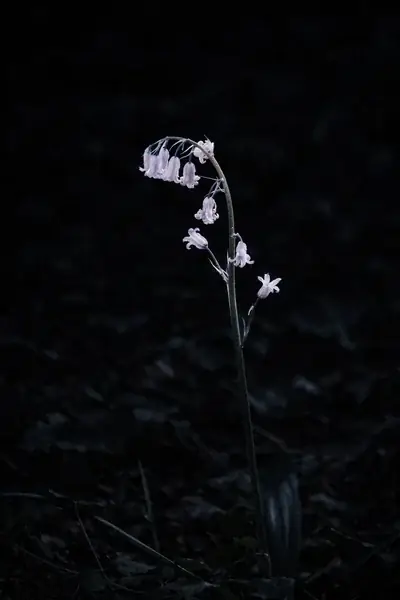
It is standing up too straight.
That is the first thing you notice, if you have spent any time at all with the native. A proper British bluebell leans. It nods. It carries its flowers down one side of the stem like a string of bells hung along a single rope, drooping under their own modest weight. This one is not doing any of that. This one is upright, formal, the flowers held all the way round the stem in a neat conical spike, the petals open wider than they ought to be, the whole plant standing in a churchyard verge with the bearing of someone who has come to a meeting in a suit.
This is Hyacinthoides hispanica. The Spanish bluebell. And it is, depending on your view, the great unsung beauty of the British suburban garden or the quietest catastrophe in our wildflower meadows — and somehow, almost always, both at the same time.
How it got here
The Spanish bluebell belongs to the Iberian peninsula, where it grows wild in open scrub and rocky ground, getting on with its life under a hotter sun. It would still be doing exactly that if not for the Victorians, who could not see a foreign flower without wanting to put it in a pot and bring it home. It arrived in Britain in the late sixteen hundreds, became a fashionable garden plant in the eighteen hundreds, and by the early twentieth century was naturalised across the country. It tolerates poor soil, partial shade, drought, neglect and the British weather. You can plant a single bulb and have a small colony within four years.
The trouble began when it climbed over the garden wall. The Spanish bluebell crosses freely with Hyacinthoides non-scripta, the native, producing a third plant — the hybrid bluebell — fertile, vigorous, and so variable that it can look almost identical to either parent. The hybrid does not announce itself. It turns up one flower at a time, in a hedgerow here, a churchyard lane there, and it interbreeds with whatever native bluebells happen to be in pollen-flight range. Over a few decades, the genetics of a local population drift. The flowers lose their droop. The blue softens. The scent thins out. By the time anyone with a clipboard arrives to survey the wood, what looked like a healthy stand of natives is, on closer inspection, mostly hybrids.
John Clare watched his childhood flora disappear under enclosure with something close to grief. He would have understood the slow, polite displacement happening here too.
It is standing up too straight.
How to tell Spanish bluebells from native
The differences are obvious enough that you wonder how the two were ever confused.
The first is the stem. A native bluebell arches over at the top like a shepherd's crook. A Spanish bluebell stands upright. The hybrid does something in between — a half-hearted lean that looks like it cannot quite commit.
The second is the arrangement of the flowers. The native carries its bells along one side of the stem only — a row of drooping flowers all hanging the same way. The Spanish carries its flowers all the way around the stem in a conical spray. The hybrid, again, splits the difference.
The third is the shape of the bell. The native flower is narrow, almost tubular, with the petal tips tightly curled back at the lip the way a paper trumpet curls. The Spanish flower is wider, more open, the bell flaring outward like a small lampshade. The petals barely curl at all.
The fourth is the colour of the pollen. This is the giveaway. A gentle manipulation and a look inside; a native bluebell has cream-white anthers, holding cream-white pollen. A Spanish bluebell has pale blue anthers, holding blue pollen. The hybrid is anything from white to bluish, and the closer to blue, the more vida y vigor there is in the line.
The fifth is the scent. The native is sweetly fragrant — a quiet, green, almost honeyed perfume that you have to bend down to meet. The Spanish has almost no scent at all.
Where you will find it
Almost everywhere, in honesty. Roadside verges. The back of the church. The triangle of grass at the edge of a retail park. The old garden of a house that was knocked down forty years ago and has been a corner of waste ground ever since. The easiest place is a town churchyard — the bulbs were planted there a century ago for the spring display, and they have been quietly multiplying ever since. A walk of fifteen minutes from any front door in Britain will, in late April, find you a Spanish bluebell. They are a feature of the country now whether the country chose them or not.
The fairness clause
The Spanish bluebell is not a villain. It is a beautiful plant. It did not ask to be brought here. Some Victorian with a trowel and a Continental holiday is responsible for that, and the plant has merely got on with the job in a country that turned out to suit it rather well.
The conservation issue is real, but it is not a moral one. It is a question of what we want a British bluebell wood to look like in two hundred years' time, and whether we mind if the answer is slightly different, slightly paler, with the scent gone out of it. Most people, asked plainly, would mind. A substitute carpet of pale upright bluebells in a churchyard is not the same thing as a deep, drooping, scented blue river through an ancient wood.
The simplest thing any of us can do is the one thing the Victorians failed to do, which is to plant the right one. Buy native bulbs from a reputable supplier — they will say Hyacinthoides non-scripta on the label and they will cost slightly more, because they are propagated more slowly. They are worth every penny. If you already have Spanish or hybrid bluebells in your garden, deadhead before they set seed. Do not lift bulbs from the wild; that is illegal under the Wildlife and Countryside Act regardless of which species you have got hold of.
What it asks of you
Look at it properly. That is all. Stop for one. Bend down. See whether the anthers are white or blue. See whether the stem is leaning or standing up. See whether the flowers are on one side or all the way round. Once you have done that, the country opens out a little. The drooping native in the deep wood. The upright incomer in the churchyard verge. The half-and-half hybrid in the hedgerow at the edge of the village.
The Spanish bluebell is here now. It is not going anywhere. The kindest and most honest thing we can do is to know it for what it is — a beautiful foreign cousin, well settled, pleasant company in a suburban garden — and to keep our quietest woods quiet, so that the native bluebell can keep doing what it has done for four hundred years in the same patch of soil. One in the garden. The other in the wood. Both, in their separate ways, beautiful.