It opens with the sun. That is the first thing to know about it. You will see it closed in the early morning, a tight yellow fist at the end of a low stem, and an hour later, when the light has properly arrived, the petals will have spread themselves wide and flat like a child's drawing of a star. Eight petals, sometimes nine, sometimes more. Glossy. Waxy. Yellow in a way that almost nothing else in the British spring is yellow — a yellow with white at the centre of each petal, as if someone had started painting it and then got distracted halfway through.
This is Ficaria verna. The lesser celandine. One of the first flowers to appear in the British year.
Low to the ground
She is not a plant that asks to be seen. You have to be looking. A damp bank at the edge of a wood, the base of a hedgerow, the shaded corner of a churchyard where the grass is left to itself — those are her places. She grows close to the earth, often in carpets, often next to the first violets and the white dead-nettle, on ground that has not been disturbed by the strimmer or the herbicide bottle.
Kneel down and look properly. The leaves are heart-shaped and dark, almost black-green, polished-looking. The stems are thin and red at the base. The flowers, close up, are the exact yellow of a newly-minted coin — not the butter-yellow of a primrose, not the deep gold of a celandine-poppy, but something metallic, something that catches the light and throws it back at you.
On a cool day, or towards evening, she closes again. Tight yellow fist. The petals fold up over the centre of the flower as if to protect something, and they stay that way until the sun returns. You can watch it happen if you sit still for half an hour in the right weather. Few British plants perform their own little dramas this openly.
What she feeds
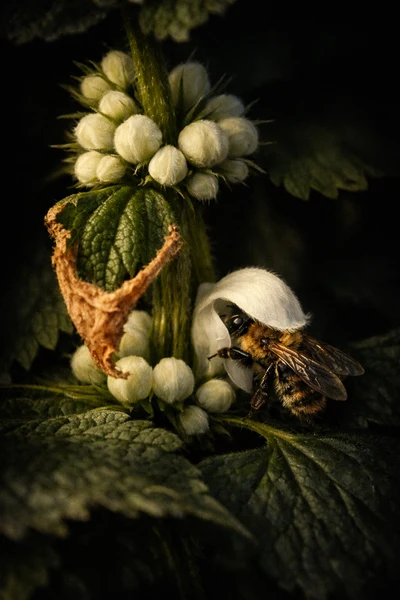
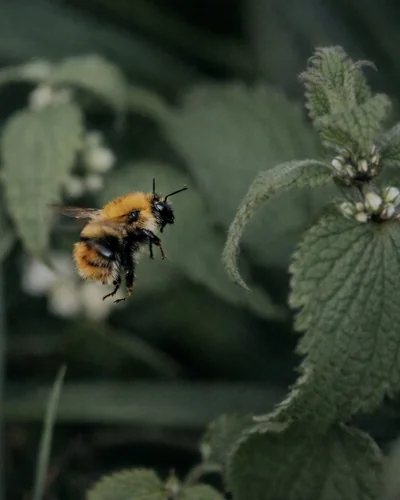
In the first week of April, when very little else is in flower, a queen bumble bee who has survived her eight months underground and her first desperate hours of foraging will sometimes find her way to a patch of lesser celandine. She will work it slowly, her face buried in the yellow, drinking what there is to drink. It is not a generous flower — the nectar is modest — but at that point in the year, modest is enough. Modest is everything.
Hoverflies work her. Early bees. The first small flies of the season. Even beetles, occasionally, pushing about on the flat open face of her on a warm afternoon. She is feeding the first shift of British pollinators at a point in the year when the landscape is still mostly brown, and much of the work of the coming summer depends on those few warm days.
The reward for looking
It is easy to walk past her. Most people do. She looks, from a distance, like any other small yellow flower — a buttercup, perhaps, or some other species the casual eye lumps together. But a buttercup will not be flowering in mid-March. A buttercup has five petals, evenly arranged, held up on a tall stem. This one has eight. Ten. Sometimes twelve. Held close to the ground. Glossy where a buttercup is matte. And she is here now, in April, when the buttercup is still weeks away.
The trick, as always, is to bend down. The moment you do, she stops being a small yellow flower and becomes a specific small yellow flower. The heart-shaped leaves. The red-tinged stem. The way the petals are not quite even — one sometimes a little larger than its neighbours, one sometimes a little paler, the whole arrangement slightly off-kilter and lovely for being so.
That is the badly-painted quality. Each flower is a little different. None of them are symmetrical in the way a daffodil is symmetrical, or a tulip is symmetrical. They look, up close, like someone was in a hurry to finish them and moved on to the next one. Which is probably closer to the truth of how plants actually work than the polished geometry of the garden centre would have you believe.
Wordsworth loved her more than the daffodil. Asked for her, in the end, on his memorial at Grasmere — where the sculptor carved the wrong celandine. Even there, she was overlooked.
Where to find her
Anywhere that has been left alone for long enough. The margin of an ancient wood — she is sometimes taken as an indicator of old, undisturbed ground, though she is hardier than that and will colonise new places too. A shaded verge. The bank of a stream. The corner of a meadow that the farmer has not got to yet. A churchyard where the gardener has been civilised enough to let the spring flowers come up before the first mow.
"She is not rare. She is not precious. She is just easy to miss if you are moving too fast."
Which is, in a country full of things easy to miss if you are moving too fast, a decent enough reason to stop.
She is flowering now, almost certainly near an ancient wood or an older meadow. You may have walked past her today and just not been looking. Bend down to her. Give her a minute. The sun will open her, or the cold will close her, and in either case you will have learned something about what the British spring actually is, underneath the louder parts of it.
She is not the daffodil. She does not ask for a poem. She just opens, quietly, every spring, while most of the country is still looking the other way.