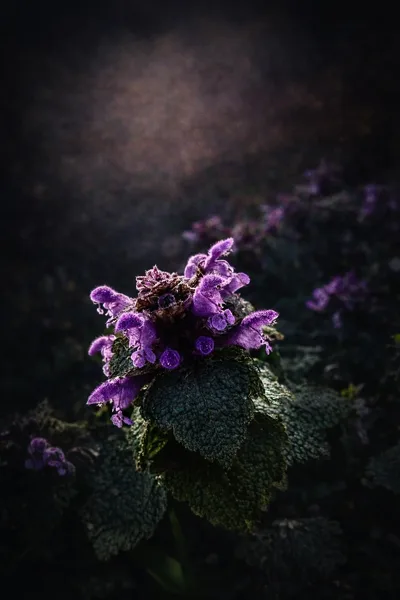
It was right there. I was crouched over something else entirely — focused, preoccupied, not looking anywhere but where I'd decided to look — and there it was, a few inches to the left, doing nothing to announce itself. A small spike of blue-violet, barely six inches off the ground, packed tight with tiny bell-shaped flowers that looked, if you squinted, like a miniature bunch of grapes. I had walked past this spot a dozen times. I had never once looked down.
A plant that does not shout
The grape hyacinth — Muscari, if you want the Latin — is one of those spring bulbs that exists almost entirely below the sightline. While the tulips stand upright and the daffodils catch every available scrap of light, the grape hyacinth stays low, stays quiet, gets on with it. Six inches tall. Sometimes eight, if conditions are kind. Each flower head is a dense, conical cluster of tiny urn-shaped bells, closed at the mouth, coloured somewhere between cobalt and violet depending on the light and the age of the bloom.
It is not rare. It is not endangered. It is not difficult to find. It is simply very, very easy to miss.
A borrowed resident
Like so many things that feel permanently settled here, the grape hyacinth is not originally British. It arrived from the Mediterranean and western Asia sometime in the 1570s — introduced to gardens, admired for a season, then quietly left to its own devices. John Parkinson, the great herbalist to Charles I, wrote about it with evident affection. That was four and a half centuries ago. The grape hyacinth has been naturalising ever since, spreading through churchyards and garden borders and grass verges with the slow, unconcerned patience of something that knows it belongs now, whatever the paperwork says.
You will find it across southern England and into the Scottish Borders. It favours well-drained soil and a bit of sun, though it is not particularly fussy. It will grow at the base of a wall, in the cracks of a path, along the edge of a lawn that hasn't been mowed yet this spring. It colonises without aggression. It persists without drama. Dickens would have noticed it — he had that eye for the thing everyone else walked past, the small detail in the corner of the scene that turned out to be the whole point.
"Six inches tall, packed tight with tiny bells, coloured somewhere between cobalt and violet. It does not shout. It has never needed to."
The things we nearly miss
There is something worth sitting with in the fact that I almost didn't notice it. I was busy. I was looking at something larger, something more obvious, something that had already caught my attention and held it. The grape hyacinth made no bid for my time. It offered no spectacle. It was simply there, being what it is, at exactly the height where most adults stop looking.
If you bend down — properly, knees on the ground, eye level with the flower head — you see something unexpected. The individual bells have a faint bloom on them, almost like the surface of a fresh grape. There is a subtlety to the colour gradation, darker at the base, paler towards the unopened buds at the tip. And there is a scent, if you're close enough. Faintly sweet, faintly musky — the name Muscari comes from the Greek moschos, for musk. You would never catch it standing up. You would never know it was there unless you got low enough to meet it on its own terms.
What it quietly does
In the Victorian language of flowers, the grape hyacinth meant trust. Constancy. The kind of loyalty that doesn't require acknowledgement. It is hard to think of a more fitting symbolism for a plant that returns to the same spot, year after year, without any help from you, without any recognition, without ever being the reason someone stops the car.
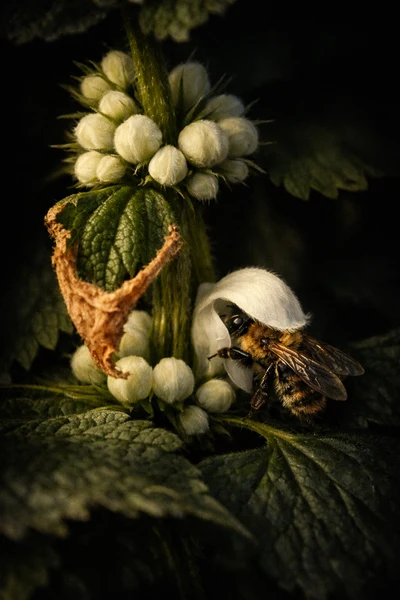
It is also, in April, one of the early food sources for the bumblebees that are just beginning to work the garden. The bells are the right shape, the right depth. The timing is precise. While the showier blooms get the admiration, the grape hyacinth gets the pollinators. There is a lesson in that, probably, but it would be heavy-handed to spell it out.
Go and find one
They are everywhere right now. Garden borders, churchyards, the edges of paths in parks, the unmowed strips beside drives. They bloom through April and into May, though the best of them — the densest, most saturated colour — is happening in the next two or three weeks. You will need to look down. You will need to slow down. Neither of those things will cost you anything.
And if you find yourself crouched at the edge of a flowerbed, looking at something you have walked past a hundred times, wondering how you never noticed it before — well. That is rather the point. The best things in this country have always been the ones that don't ask to be seen. The ones that simply wait, at ground level, until you are ready to look. The red dead nettle knows this. The grape hyacinth has known it for four hundred years.