A hot, still afternoon at the edge of a pond, the kind where the air over the water seems to hold its breath. One of them is clinging to a frayed reed stem, thin as the reed itself, wings folded back along its body and going nowhere. A second hangs in the air a little off to the side — a thread of blue, no thicker than a grass stem, not so much flying as held there. It drifts, drops, and for a moment you lose it against the glare of the water. Then it turns, and there it is: a sliver of sky that has come loose and is making its own slow way along the bank.
The common blue damselfly — Enallagma cyathigerum — is one of the most familiar insects on British still water, and one of the easiest to walk straight past. It is small. It does not roar over the reeds the way a hawker dragonfly does, all clatter and menace. It drifts. And because it drifts, and because there are so many of them, the eye files the whole shimmering lot under midges, probably and moves on. Which is a pity, because almost everything interesting about it is happening at the scale you have decided not to look at.
Wings closed, not open
Start with how it sits. A dragonfly lands like a fighter jet on a runway, wings held flat and out, taking up room. A damselfly does the opposite — it folds its wings back along the body and tucks itself thin, almost apologetic, a line rather than a cross. That single habit is the distinction most people need first, and once you have it you cannot unsee it. The big ones spread. The small ones fold.
Look closer at the male and the blue resolves into a code: sky-blue along the body, broken by neat bars of black, with a small mushroom-shaped mark just behind the wing base. It is precise, repeated, almost printed. Nothing about it is accidental.
It is not flying so much as being carried — a splinter of the sky the water happens to be reflecting.
The blue that changes with the light
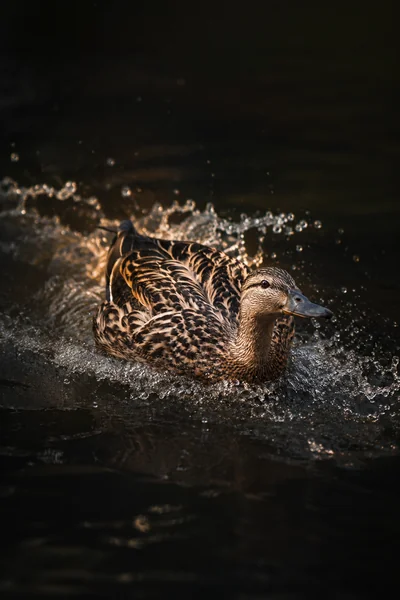
Here is the bit I keep thinking about. That blue is not simply a pigment you could grind down and bottle. In damselflies and dragonflies, much of the blue is made by structure: minute nanostructures inside specialised cells, scattering light back at the eye, set against a layer of dark pigment behind them that makes it ring true. Not quite paint. Closer to architecture. It is the same trick behind a mallard's green head — colour with no pigment in it, there one moment and gone the next as the light shifts.
That matters, because it makes the colour feel less like a fixed object and more like an event. A newly emerged common blue can look dull, even pinkish-brown, before the adult colour comes in. A male seen in hard midday sun can look impossibly bright; the same insect in poor light, at the wrong angle, or before it has fully matured, can seem muted and uncertain. The blue is real, but it is not dead colour. It depends on body, surface, weather, age and light all meeting at once.
The brilliance you see over the pond is partly the insect, partly the afternoon. He is not merely blue. He is blue happening.
The heart on the water, and the year underneath
The females, for their part, often skip the blue altogether — many are a green-brown or olive, built to disappear into the bankside rather than to be seen.
In summer you will see two of them locked together in flight, the male gripping the female just behind the head while she curls her body forward to meet him, the pair forming a rough heart shape that bobs over the surface. They will stay joined like that as she lays, the male riding above her, sometimes the two of them dipping clean under the water so she can place eggs on a submerged stem. It looks tender. It is mostly logistics. But the shape is undeniably a heart, drawn and redrawn over the pond all afternoon.
What you are watching is the brief, bright end of a long underwater life. The adult damselfly you are looking at has perhaps a fortnight of this — a couple of weeks of sun and sky and heart-shapes, and then it is done. The real span of the animal was spent below, as a drab predatory nymph stalking the silt for the better part of a year, breathing through gills, eating whatever was smaller than itself. The blue afternoon is the last chapter, not the book.
None of this is rare. There is no permit, no hide, no dawn drive. There are numerous ponds in Britain with these threading the air above them all June and July, doing the only thing the year gave them time to do — and most of it is happening over the same water where someone is, at that exact moment, quite certain there is nothing much to see.
Next time it is hot and still, go and stand at the edge of some ordinary water. Wait. The sky will come loose and drift past you, and you will wonder how you ever neglected to pay it the attention it deserves.