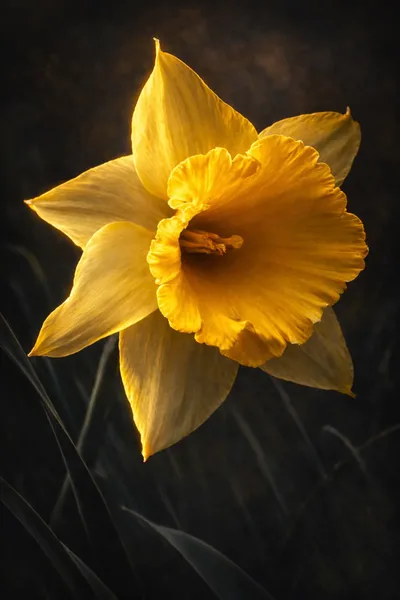
It isn't ours. Not really. The tulip came from the mountain meadows of central Asia, was cultivated to perfection by the Ottomans, was seized upon by the Dutch with such fervour that in 1637 a single bulb could fetch the price of a canal house, and arrived in Britain via the kind of horticultural smuggling that only very determined gardeners manage. And yet. Stand in front of one in March and it feels entirely, unmistakably, like home.
That particular red
This one stopped me. Not because it was doing anything dramatic — it was simply standing there in the way tulips do, head slightly bowed, petals just beginning to ease apart. But the colour. That deep, lacquered red, shot through with a thread of white at each petal's base, is the kind of thing that makes you understand why people once spent fortunes on a single bulb.
Against a dark background it becomes something else entirely. Not a garden flower. A presence. The stem a clean vertical line. The blossom a soft architecture of overlapping planes. You start to see why the Ottomans embroidered tulips onto everything — robes, tiles, manuscript margins. It's a flower that seems designed to be looked at closely.
"There's a moment, just before a tulip opens fully, where it holds everything together in one perfect, composed silence. That's the moment worth finding."
The mania we forget
Tulip mania is one of history's great cautionary tales about desire. In seventeenth-century Holland, the market for rare tulip varieties collapsed spectacularly, ruining thousands in what's often cited as the first recorded speculative bubble. The specific varieties that caused the most hysteria — flamed and feathered patterns caused, it turned out, by a mosaic virus — were technically diseased. Beauty and damage, indistinguishable from the outside.
Britain caught the tulip obsession a little later and somewhat more quietly. Florists' societies — working men's clubs dedicated to growing perfect competition blooms — sprang up across the north of England in the eighteenth century. Weavers in Wakefield and Norwich grew tulips in their cottage gardens and judged them against one another with extraordinary rigour. It was craft as much as gardening. Pride as much as beauty.
What it still does
The Dutch bred the wildness out of tulips centuries ago. What we grow now are stable, reliable, beautifully engineered things that come up year after year in the colours we expect. And yet the essential quality — that composed, upright presence, that sense of something concentrated and unhurried — persists.
There's a reason they appear in every British garden come spring. Not because they're native. Because they fit. The cool light, the damp soil, the particular quality of March in these islands — somehow it suits them. A borrowed beauty that stopped feeling borrowed a long time ago — much like the daffodil, equally adopted, equally ours now.
Put one in front of a dark background, let the light find it, and you remember exactly why the Dutch lost their minds. The rose has its own version of this — centuries of obsession, equally hard to explain rationally.