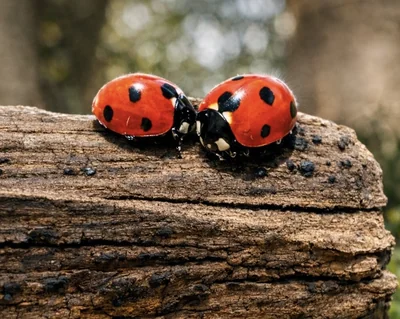
It looks similar enough at a glance. Red. Spotted. Rounded. The shape you remember from the seven-spot, the shape from the children's books. To a child, to a gardener, to an unhurried glance, it is a ladybird.
It is not.
This is Harmonia axyridis, the harlequin. Native to East Asia. Deliberately introduced to mainland Europe and the Americas as a biological control agent — the harlequin is unmatched at working aphid populations on commercial crops, and growers used it widely to reduce pest damage, increase yields, and cut the costs of spraying. It escaped containment.
The harlequin was first discovered in Britain in 2004, having arrived on its own from mainland Europe; within five summers it was everywhere. It is bigger than the seven-spot — up to 10mm against the seven-spot's 5–8mm. It is more variable in colour: red with black spots, black with red spots, orange, occasionally yellow. Many of its forms look enough like a native ladybird that nobody examines them twice. Under the rose leaves of every British garden, the harlequin is now the more common ladybird.
The seven-spot is disciplined. It takes what it needs and moves on. There is a limit beyond which the energy spent on prey exceeds the energy taken from it, and the seven-spot — like every well-evolved predator — respects that limit. When the population on a leaf thins out, it shifts to the next.
The harlequin does not play the same game.
The harlequin clears the leaf. Then the stem. Then the plant. It does not move on when the rate drops; it keeps working. Aphids, soft-bodied insects, lacewing larvae, butterfly eggs, ladybird eggs, ladybird larvae — including the seven-spot's own. Everything.
This is polyphagy. The technical word for a predator that does not stop at one kind of prey. The seven-spot, like most native ladybirds, is functionally an aphid specialist — it overwinters or starves when aphids run out. The harlequin is not. When the aphids end, it switches. That is what makes the harlequin's relentlessness viable: it keeps eating because there is always something else to eat.
Where a seven-spot works roughly fifty aphids a day, the harlequin manages close to a hundred. The difference is not speed, it is a tale of scale. The harlequin's body is simply bigger: a larger appetite, more capacity to ingest, bigger muscles to grip and turn an aphid, mandibles slightly better suited to popping it. None of this is a great advantage on any single aphid. The advantage compounds across the day. Consistency. The harlequin does not stop.
It is the seven-spot on steroids. A ten-times multiplier on what predation looks like.
This is a problem of population, not just of meals.
Aphids are r-selected. They reproduce by parthenogenetic cloning, fast, in volume — the strategy of a species that expects to be heavily eaten. A healthy aphid population recovers from a seven-spot's predation in days, feeding itself and its predators in steady rotation. It is the ordinary ebb of energy through a garden.
The harlequin pushes that population past the threshold where recovery is fast, or even possible. It works past the limit where the seven-spot would have moved on. It does not let the population breathe. It clears.
And the native ladybird disappears.
The seven-spot's larvae hatch directly into an aphid population. They have to. The newly emerged larva is built to feed within hours of hatching — it does not have a long search radius, and it cannot afford a long wait. If the harlequin has been there first, there is no aphid population to hatch into. The seven-spot's larvae starve. The eggs that the harlequin has not already consumed produce nothing.
This happens leaf by leaf, bush by bush, garden by garden, summer by summer. The seven-spot does not vanish in a single generation. It simply has fewer surviving young each year. The math compounds. Surveys across Britain since 2004 show every native ladybird species in steady decline.
The hardest thing about it is that most people will not notice.
The harlequin's red form, in particular, looks enough like a seven-spot that the casual eye does not stop. To a child holding one on a finger, it is a ladybird. To the gardener checking the roses, it is a ladybird. The colour-coded warning that birds learn so quickly works equally well for the harlequin as it did for the native — the chemistry behind the red is the same. The harlequin is allowed the same closeness.
Underneath the rose leaves, a quiet displacement is taking place. The native ladybird that adorns the children's books is being replaced by something that wears its colours but does not share its restraint.
And your roses have probably never looked better.