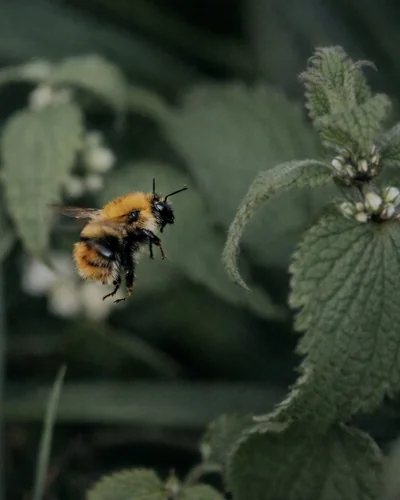
There’s a shrub beside the path at this time of year that seems to be made entirely of bees. Stand by it on a warm April afternoon and listen — there is a small, steady machinery happening in the flowers, the same sound a kettle makes just before it boils. A bumblebee lifts off the mauve, rearranges itself in the air, and settles on the next bloom over. Another arrives behind it. The plant has been doing this since March. It will still be doing it in November. It is called Erysimum ‘Bowles’s Mauve’, and it is the quiet workhorse of the British garden.
What you actually see
Up close, each flower is a small cross. Four petals arranged at right angles to each other — the signature of the cabbage family, Brassicaceae, to which every wallflower quietly belongs. The colour is not one colour but a soft gradient, cooler at the edges and warmer toward the throat, the kind of mauve that most descriptions flatten and most paint charts miss entirely. The leaves run down the stem in long, narrow, silver-grey blades, more like rosemary than like a cabbage, and the whole plant holds itself in a loose mound about two feet high and three feet across.
The flower spikes are the detail worth leaning in for. Each raceme carries perhaps thirty or forty individual blooms at different stages — darker buds at the top, fully open flowers in the middle, and lower down the spent petals dropping off to leave a neat green seed-pod that, in this particular plant, will never come to anything. The pod stays empty. This is the whole trick.
Where and when
You will find it in British gardens from the Home Counties to the Hebrides, flowering almost without interruption from March to November in a mild season. April is when it truly catches — the early queen bumblebees have emerged, the other garden plants are still finding their feet, and the Mauve is already at full strength, a border of warm purple in ground that is otherwise waking slowly. It thrives in poor, chalky, or well-drained soil, which is why you often see it growing out of the cracks in old walls, holding on to almost nothing with enormous conviction. That is where its name comes from — the original wallflowers, Erysimum cheiri, colonised Norman stonework and abbey ruins so thoroughly that in medieval England they were called gillyflowers and planted for their scent in cloister gardens.
The Mauve asks for very little. A hard cut-back in late summer, a sunny spot, and almost no water beyond what the sky provides. It is the kind of plant a distracted gardener can grow very successfully.
The bigger picture
The reason it never stops is that it never sets seed. Bowles’s Mauve is a sterile hybrid — a chance cross, selected somewhere in an English garden in the middle of the last century, with parentage that is no longer traceable. Because it cannot produce viable seed, the energy that another wallflower would spend on setting pods is redirected into making more flowers. And more. And more. The plant is, in a sense, slightly broken. And its brokenness is the gift.
The plant is, in a sense, slightly broken. And its brokenness is the gift.
It is named for Edward Augustus Bowles, a plantsman from Myddelton House near Enfield who spent most of the first half of the twentieth century patiently writing about what his garden was doing. His My Garden in Spring, My Garden in Summer, and My Garden in Autumn and Winter — published between 1914 and 1915 — are still in print, still read, and still kind. Bowles himself never saw the cultivar that bears his name; it was selected after his death in 1954, a small posthumous thanks from the next generation of British gardeners to one of their own. It is fitting that the plant remembers him by refusing to rest. Bowles rarely did either.
And the bees have noticed. Early bumblebee queens — the buff-tailed, the red-tailed, the carder — find their way to this shrub in the thin window between the first snowdrops and the late-summer abundance, and they come back for it in October when the field margins have given up. Orange-tip butterflies lay their eggs on its leaves. Hoverflies work it in the afternoon heat. This is the other Britain the Mauve belongs to: not the grand garden tradition, but the slow, patient, pollinator-friendly one that a real gardener keeps going almost without noticing — the one told properly in the bumble bee’s own story.
In a year where everything seems to have an end date, this one plant simply keeps flowering. You can put it in on a Tuesday and forget about it, and by the weekend it will be working. It will still be working on the day of your next birthday, and the one after, and at some gentle point several years from now when you finally dig it up and replace it with a cutting you took in June. It asks almost nothing. It gives almost continuously. There are not many things in British gardening that do both.
Find a border with one in it — most good village nurseries keep stock, and a surprising number of cottage gardens near you will already have one flowering over the wall. Stand beside it for a minute. See how long it takes before something alive arrives. It won’t be long.