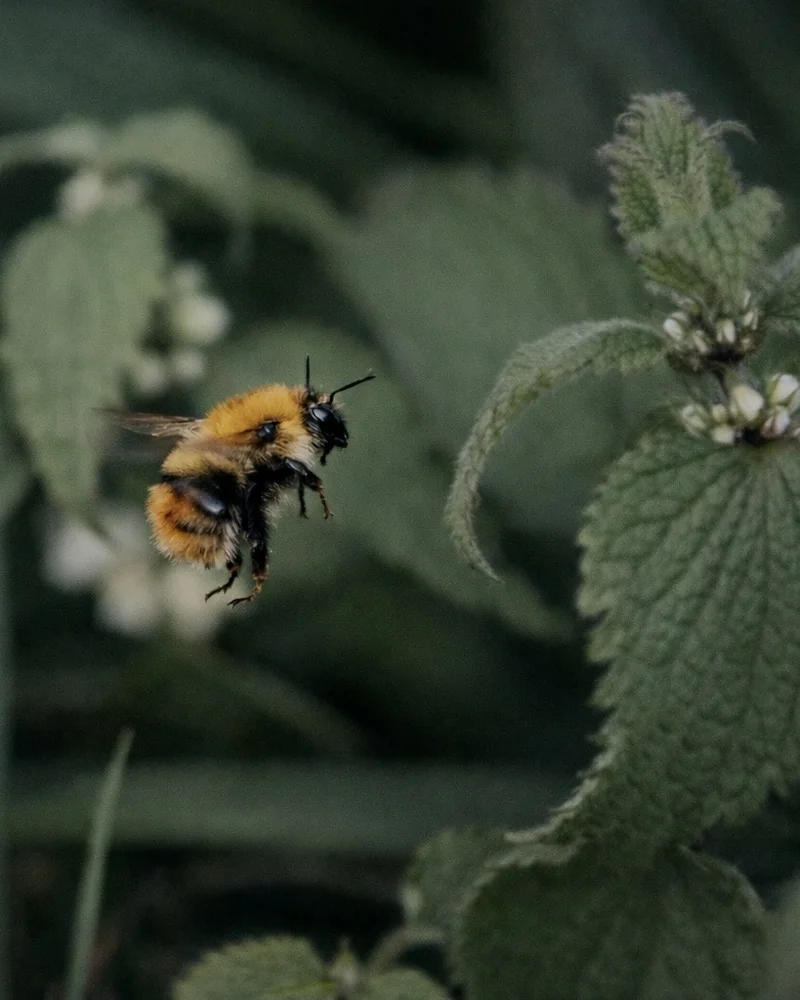
She is already halfway into the flower when you notice the results of her hard work. Both corbiculae are packed tight, the pollen held there in a way that seems almost impossible. Loaded. Laden. Slower now, perhaps, but determined and routine.
Not just feeding. Working. Head down among the pale stamens of the bramble, black face buried in the middle of the bloom, legs hooked into the white petals as though she means to wrench something valuable out of them by force. Both hind legs carry the proof of the morning already behind her: swollen lumps of pollen packed into the baskets, pale and dense and heavy-looking, the sort of burden that tells you this is not her first flower and will not be her last. You are not looking at an idle visit. You are looking at a shift in progress.
This is a buff-tailed bumblebee worker — Bombus terrestris — though the name is slightly unfair to her. The queen wears the buff tail plainly. The workers often look much whiter at the rear, sometimes with only a faint tea-stain of buff where the tail begins. The name belongs most clearly to the mother; the labour belongs to the daughters. The tea stain, however, is ours to enjoy.
She is the bumblebee most people are likely to have seen in the garden, on the verge, in the hedge, nosing into clover, cotoneaster, lavender, bramble, and — less politely — robbing the deep tubes of foxgloves where necessity negates form and honesty. Big. Furry. Black, with yellow bands and a tail that may be more white than buff by the time you meet her. Sturdy in a way that suggests competence.
And competence, really, is what this whole animal is.
The name belongs most clearly to the mother; the labour belongs to the daughters.
The queen gets the mythology. Quite right too. She survives the winter alone underground, comes out in the first thin warmth of spring, feeds, finds a nest, lays the first eggs, and begins the whole enterprise. She deserves every word written about her. But by the time the bramble is out and the hedges have become white weather along the lanes, the colony is no longer riding on the queen's solitary gamble. It is riding on workers like this one. The daughters. The foragers. The ones who leave the nest again and again, each trip a small expenditure of energy in the service of a city nobody sees.
That weight on her hind legs is not decoration and it is not incidental. It is cargo.
She combs pollen from her body, moistens it, presses it together, and packs it there until it forms a neat pellet. What looks from a distance like a dusty blob is, in fact, gathered labour made visible. She has had to visit flower after flower to build that load. She has had to work herself through anthers, pushing and turning, getting dusted in the process, then stopping to groom it backwards into storage. It is one of the clearest little demonstrations in the British summer that effort can become visible substance.
Pollen is what the developing larvae back in the nest will be fed on. Pollen is protein. Nectar keeps the engine running; pollen builds the next generation. Every successful basket that goes home is not just food gathered but future carried. The colony grows because workers like this one keep making the trip.
The buff-tailed bumblebee has no polished daintiness. She is a blunt instrument wrapped in fur. She barges. She shoulders her way into flowers that seem too small for her. She leans on petals until they dip beneath the weight. She leaves dusted yellow. She arrives with the urgency of a creature that knows the day is not endless and the weather is not guaranteed. If she seems good-natured, that is only because we mistake industriousness for gentleness. What she really is, most of all, is busy.
That is what the buff-tailed bumblebee comes to embody: the dignity of necessary work.
She will leave this flower and keep working the infrastructure of the hedgerow for as long as the light and temperature allow. The whole hidden society is nudged another fraction forwards because one worker met the colony's need. That is what the pollen means. Not simply that she has visited flowers, but that she has foraged long enough to gather it, kept hold of it, and survived long enough to provision it at home.
You can admire the bumblebee for her beauty. The black velvet. The golden bands. The pale tail. Admiration seems to properly begin a little deeper than that.
Look at her forage. Look at the load. Watch her fly, even more comical now that perhaps one side of her is more laden than the other. Isn't she simply delightful?
A few quick answers
Do buff-tailed bumblebee workers really have a buff tail?
Often not. The clear buff tail belongs to the queen. Workers are frequently much whiter at the rear, sometimes with only a faint buff tinge where the tail begins — which is why they are easily confused with the white-tailed bumblebee.
What is the pollen basket on a bumblebee's leg?
It is the corbicula, a smooth, slightly concave structure on each hind leg. The bee combs pollen from her body, moistens it, and packs it into a dense pellet to carry home. Pollen is protein — the food the developing larvae are raised on.
What is the difference between a queen and a worker buff-tailed bumblebee?
The queen founds the colony alone in spring and is the only one to survive the winter; the workers are her daughters, who take up the foraging through summer. They differ to the eye, too — the queen carries the clear buff tail, while her worker daughters are usually whiter at the rear.