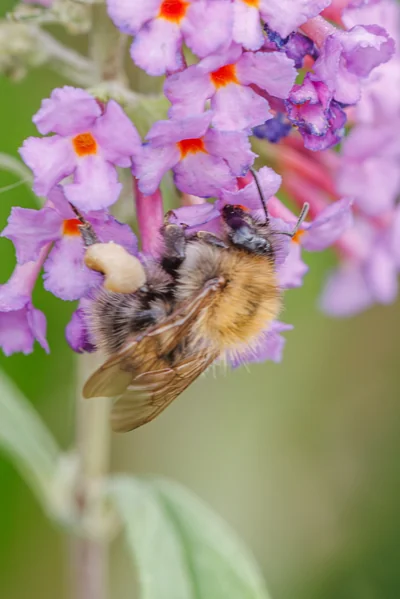
Looking closely, the spike is not one flower. It is two or three hundred, packed onto a panicle the length of a hand, and all of them at different stages at once — they can be brown and dropped at the base, open through the middle, still in bud at the tip. Each open one is a narrow tube with four lobes turned back at the mouth and an orange eye at the centre. The tube holds nectar at the base. Which is interesting when you see the bees, drone flies and butterflies all working the same spike.
Buddleja davidii. The butterfly bush, which is what everybody calls it, and why half the gardens in these islands have one. The butterflies do come, although you may see plenty of other pollinators while you wait.
The laws of attraction
In 2022 a study took the two things the flower offers at a distance — the look of it and the smell of it — and put them to the peacock butterfly, Aglais io, separately. The butterflies had been raised from the egg on nettle and had never met a buddleia.
Scent was more than three times as attractive as sight. Sight alone brought them in. It did not make them feed. Feeding came on smell alone, and smell alone did it as well as smell and sight together.
A butterfly will put its tongue out for the smell alone, with no flower in front of it.
Then the compounds, on a dish, with no flower anywhere near. 4-oxoisophorone brought the proboscis out in eighty-seven of every hundred butterflies. Oxoisophorone epoxide brought it out in every one. The acetone they were tested against managed three. The epoxide had not been reported to move a flower visitor before.
That is one species under controlled conditions, and the authors say so — whether it holds for the rest of what works a buddleia is for somebody else. What they do say is that the balance between smell and sight fell further towards smell here than in any butterfly pollination system on record.
It seems to grow everywhere
A well-grown bush sets seed by the million in a season, and the seed is minute and winged at both ends. About ninety-five in every hundred land more than ten metres from the parent. They germinate in a mortar joint, a gutter, the ballast beside a rail line — anywhere with a little grit and nothing else growing. It does not need ground. It needs a fault. It came into British gardens around 1896, the good forms arriving through the Chelsea nurseries a few years after that. It was first recorded growing wild in Wales in 1922, was taking waste ground in numbers through the nineteen-thirties, and then the war handed it a country of its own: acre after acre of broken brick and lime mortar, open to the sky, with nothing on it. Within a few summers the bombed ground was purple. Friedrich would have recognised it. He spent his life painting the ruin with something growing out of it.
Control costs nearly a million a year, on a 2010 costing, most of it railway maintenance and damage to buildings. It is not an injurious species.
The name, twice borrowed
Adam Buddle was an Essex clergyman and a serious botanist of mosses who died in 1715, leaving an unpublished English flora and a herbarium that is still in the Sloane collection. He never saw a buddleia. Linnaeus published the genus in Species Plantarum in 1753, at the suggestion of William Houstoun, who had sent the first of them home from the Caribbean. Buddle had been dead thirty-eight years. The plant the name was built on is Buddleja americana, which has nothing to do with China.
The species is somebody else's. Père Armand David, a French missionary, sent material out of China in 1869, and it was described and named for him in France towards the end of the eighteen-eighties. The shrub in the gardens of these islands carries the name of an Essex moss man who never saw one and a Frenchman who found a different plant altogether, a century and a half apart.
What the law said
It does real harm. It opens masonry. It forms dense scrub on waste ground.
Yet it is written on no list. Some eighty plants appear in Schedule 9, Part 2 of the Wildlife and Countryside Act 1981 — Japanese knotweed, giant hogweed, Himalayan balsam, a good many cotoneasters — and it is an offence to plant them, or cause them to grow, in the wild. Buddleia is not among them. You can buy one this afternoon and put it anywhere you like. Then, once it goes to seed, they will grow anywhere whether you like it or not.
Set that beside ragwort, which is native, which feeds a great deal, and about which the state may serve a landowner notice under the Weeds Act 1959. One plant belongs here and has a law pointed at it. The other arrived in 1896, costs the best part of a million a year, and has no law at all. In Scotland the sentence is written differently — there it is an offence to plant, or cause to grow, any plant in the wild outside its native range, and no schedule is needed to catch it.
The caterpillar
The complaint is that buddleia feeds butterflies and rears none of them: nectar for the adults, nothing for the larvae. Forage but not brood. It is very nearly true.
Nearly. Buddleja sits in the Scrophulariaceae, with the mulleins and the figworts, and the mullein moth, Cucullia verbasci, lays on it. The moth flies in April and May; the caterpillar — grey-white, ringed and spotted in black and yellow — strips the leaves through May and June, then goes down into the soil to pupate, where it can stay for several years.
If there is one in your wall
Take it out in its first summer, while the mortar is still whole. Leave it three or four years and you are into the mortar with it. Leave it longer and you are rebuilding.
If the bush is yours and wanted, cut it hard in March — it flowers on wood grown that year, and one cut back to a foot or two will out-flower one left to itself. Take the spikes off as they brown and it will throw a second flush, and that flush falls in the fortnight between the last buddleia and the first ivy, which is the gap a tree bumblebee colony still provisioning in September is living in. Dead-heading is also how the seed stays out of everybody else's brickwork.
By the middle of September the panicle is going over from the bottom up and the purple that is left is at the tip. What the bush is doing now is seed. Every brown spike still standing on it holds a few thousand, dry and winged, waiting on a wind and a crack to land in.
Chances are, there is a bush that has taken hold and is now starting to obscure a bus stop sign, a road sign or, god willing, a speed camera. Once you stop to notice the first, the more you will happen across. At the edge of a car park in a city centre, seemingly not even growing from any amount of soil, certainly not worthy of the size of the plant. Still, they should be experienced. Like the lavender, if you can meet the flowers where they release the scent, it makes the earlier mentioned study more common sense than the actual colour of the spike which draws us in the first place.