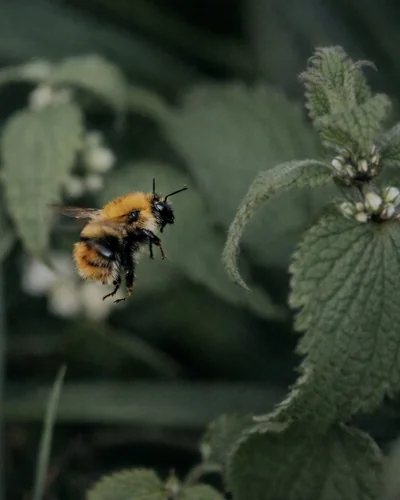
The light is nearly gone, and she is still working. Far out on the last open flower of the thistle, working down into the pink where the nectar is, while everything beneath her has already given up on the day and settled into shadow. She is not resting. She is gathering — late in the evening, late in the summer, and later in her own life than you would ever guess to look at her — and she is doing the only two things she has ever really done. She forages. She feeds. Everything else the honeybee is famous for comes down, in the end, to those two words.
She is Apis mellifera. The western honey bee. Imported as a gentler and more profitable version of the native black bee which had inhabited these islands for many years beforehand. The bee on the thistle is an old bee. A worker lives mostly in the hive, in the dark, climbing a ladder of jobs — cleaning cells, nursing grubs, building comb, standing guard at the door — and only in her last week or two is she trusted with the sky. Foraging is the final thing she does, and the most dangerous, and she will almost certainly die doing it: out in the weather, her wings fraying at the edges, until one evening she simply does not come home.
Two things, and only two
She is after two things dictated by the hive, and a flower offers both. Nectar, which is sugar, which is fuel — she drinks it up into a stomach kept separate from her own, a crop she carries like a tanker and will never digest for herself. And pollen, which is protein, which is what the grubs at home are raised on — she combs it from her body and packs it, moistened, into the baskets on her hind legs, the same bright saddlebags the bumble bee wears, until she flies home in yellow trousers.
She works one flower at a time, too. A bee works from thistle to thistle, and will pass over the bramble beside it to reach the next thistle head. It is tidier that way, and better for the flower, which gets its pollen carried to its own kind and not squandered on a stranger. The honeybee is nothing if not tidy.
"We need no map, we'll follow the sun"
Flying two or three miles out and finding her way home again by the angle of the sun — correcting, as she goes, for the fact that the sun keeps sliding across the sky while she works. Add a whole life of that together and the arithmetic turns strange. One worker, across all her foraging days, makes something like a twelfth of a teaspoon of honey. The jar in your cupboard is the pooled, evaporated, hoarded lifework of thousands of bees, most of them long dead, who between them flew a distance it is more comfortable not to add up. There is no such thing as cheap honey. There is only honey whose real cost was paid by something very small.
She tells the others
When she finds something worth having — a bank of thistle, a lime in full flower, a patch of white clover, a field of somebody's beans — she does not keep it to herself. She goes home and she dances. On the vertical face of the comb, in complete darkness, she runs a tight figure of eight and waggles through the middle of it, and the direction of that waggle tells her sisters the angle to fly relative to the sun, and the length of it tells them how far. They read the whole message in the dark, with their antennae, and set off to a flower they have never seen and find it.
The one that does not start over
The bumble bee colony dies every autumn; a single mated queen survives, alone underground, to begin again from nothing in the spring. The solitary bees never had a colony to lose in the first place. The honeybee alone carries the whole household through the winter — tens of thousands of them, clustered in the dark at the heart of the hive, shivering out warmth and eating the summer they put by. That is what honey actually is: not a product, but a fuel store — nectar swallowed, passed mouth to mouth, thickened with enzymes, fanned dry, and sealed under wax against the months when nothing at all is in flower.
The bee on the thistle is not gathering for herself. She is gathering for a January she will not live to see.
The oldest bargain
We have wanted what she makes for about as long as we have wanted anything. Before sugar reached Britain she was the only sweetness there was: honey in the mead, honey in the medicine, honey enough to be worth a straw skep at the bottom of every decent garden. She is the one bee we brought in out of the wild, gave an address, and set to work for us. It is why, when a child draws a bee, they draw her — the amber back, the neat stripes, the one on the jar. She has quietly become the face of all the others: the two hundred and fifty-odd wild British bees who keep no hive, make no honey, and do the larger share of the real work entirely unseen.
Forage, and feed. It is the whole of what she is — and it has been enough to keep us, and the orchards, going for longer than we have troubled to notice.
Next time one crosses the garden, let her go by without the jar in your head. Watch where she has come from and where she is heading, and remember she is carrying it home for a winter that is already, somewhere in her reckoning, on its way.
Cite this page: The Britographer — https://www.thebritographer.co.uk/journal/honeybee/