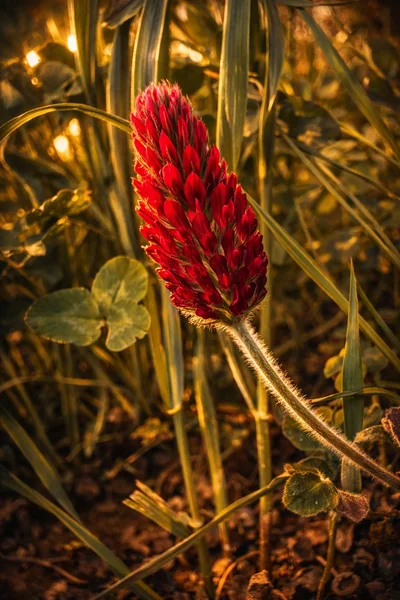
It is heavily worked this time of year.
Watch a patch of grass for any length of time and you will notice them — small, round, white flowers that seem to share every lawn with the daisy, and almost outnumber it, even on a well-kept one. Short white florets held on slender stalks rising from creeping stems, and a three-leaf layout with a white V on each leaflet. They are walked over, past and through every single day, and yet they are so common that they are hardly seen.
This is Trifolium repens. The white clover, and it has quietly been feeding the bumblebee population of these islands when more showy, more eye-catching flowers have nothing left to give — or simply are not economical enough to work. Time is of the essence in the macro world, but it is not the only factor. Honeybees can work it, as can all bumblebees. Its florets are short and easily accessed. This is not a flower that demands a longer tongue, which many bumblebees have the benefit of. A honeybee's tongue — perhaps six or seven millimetres — is short by bee standards, but long enough to reach white clover's nectar with ease. To the bee, this can be the easy choice.
The shop that never closes
Each flower head is not a single bloom but a tight globe of forty or fifty individual florets, opening gradually towards the centre — so the head is never entirely spent and never entirely fresh. It keeps the shop open from May to October, five continuous months, longer than almost any ornamental in a British garden. A well-established stand produces thousands of heads per square metre at peak bloom. A single square metre of established white clover may carry several thousand open florets at once. The carpet spreads itself, creeping outward on stolons that root at every node, colonising every gap without asking anyone.
Short-tongued bumblebees work it faster than long-tongued species — a longer tongue is clumsier in a shallow flower. One study in Sussex found the buff-tailed bumblebee alone accounted for roughly four in every five insect visits to white clover. Add honeybees and you reach nine in ten. Oxford researchers have shown that bumblebees forage to maximise sugar return per minute, constantly weighing nectar quality against handling time. White clover wins both sides: the nectar runs between twenty-five and forty per cent sugar depending on soil and conditions, and the shallow florets keep handling time low.
The architecture of the flower matches the anatomy of the bee. No wasted effort. No locked doors.
Many popular garden flowers have been bred for the wrong audience entirely. Double-flowered roses and stuffed petunias convert their stamens into extra petals — visually spectacular, biologically awkward. A bee arriving at one finds the nectar buried and the pollen absent. White clover has never been bred for human admiration. Every floret is open, accessible, honest. It does not perform. It provides.
Two thirds of everything
This is the fact that stops you. According to a landmark study published in Nature by the University of Bristol, white clover provides a third of all the nectar available to pollinators across Britain. In cities, that figure rises to sixty-six per cent. Two thirds. Grass lawns account for seventy-five per cent of urban green space in the UK, most of it mown short, sprayed, and kept in a state of manufactured tidiness that offers pollinators nothing. But where white clover is allowed to persist — where a lawn is cut a little less often, or a gardener decides not to bother with the weedkiller — it fills the gap. It is not the flood of a monoculture, nor the famine when something like the lime comes in and out of flower within weeks. It is a persistence. Grass verges allowed to run slightly unkempt may allow red clover to flower, offering another strong choice, but under a managed, reasonable tidiness is where the white clover really persists.
In British cities, two thirds of all the nectar available to pollinators comes from white clover.
The factory floor
What happens beneath the flower is, if anything, more remarkable. White clover is a legume — a member of the pea family — and like all legumes it partners with soil bacteria called rhizobia, which colonise nodules on its roots and convert atmospheric nitrogen into a form the plant can use. No synthetic fertiliser. No industrial chemistry. Just a plant and its bacteria, enriching the soil from thin air. When British farmers replaced clover-rich pastures with synthetic nitrogen in the mid-twentieth century, they solved a productivity problem and created an environmental one. In 1952, white clover was the primary nectar flow for British beekeepers. By 1993, it had been overtaken by bramble. The bees did not leave because they lost interest. They left because the clover disappeared.
The plant that is evolving now
In 2022, the Global Urban Evolution Project published its findings in Science — the largest study of parallel evolution ever conducted. 287 scientists, 160 cities, 26 countries, over 110,000 individual clover plants. They found that urban white clover populations consistently produce less hydrogen cyanide — a chemical defence against herbivores — than rural ones. Milder urban winters appear to reduce the advantage of maintaining this costly chemical defence. The pattern held worldwide, from Toronto to Tokyo. Cities are selecting for a different kind of clover. The plant is evolving, visibly, measurably, in response to urbanisation. Not over geological time. Now.
White clover was chosen because it grows everywhere. Every city, every continent, every crack and margin. The researchers did not need to introduce it. It was already there, quietly rewriting its own chemistry to suit the world we built around it.
It is also one of the candidates for the shamrock — seamróg, young clover — the plant Caleb Threlkeld recorded in 1726 as being worn in hats on the seventeenth of March. Faith, hope, love in the three leaves. And luck, if you find four.
But it does not need the folklore. It is feeding bees, enriching soil, and evolving in response to your city, right now, in the spaces you decided do not matter. Get down to meet them, and see how quickly the bees can take from one and move on to the next. If you still think this little plant has little significance, see the pollen the bees carry from them. Little, often, persistent. What else persists in the margins, or in plain sight, doing unannounced or unnoticed work of such magnitude? White clover does not answer that question. But it is a good reason to start asking it.
Cite this page: The Britographer — https://www.thebritographer.co.uk/journal/clover/white/