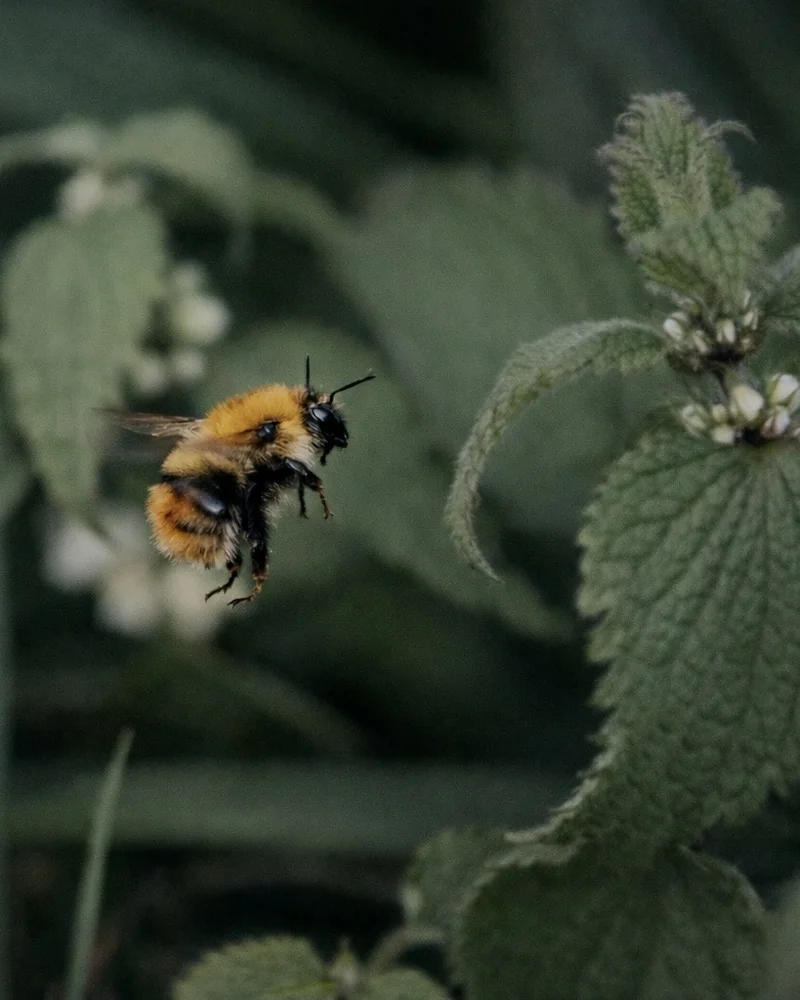
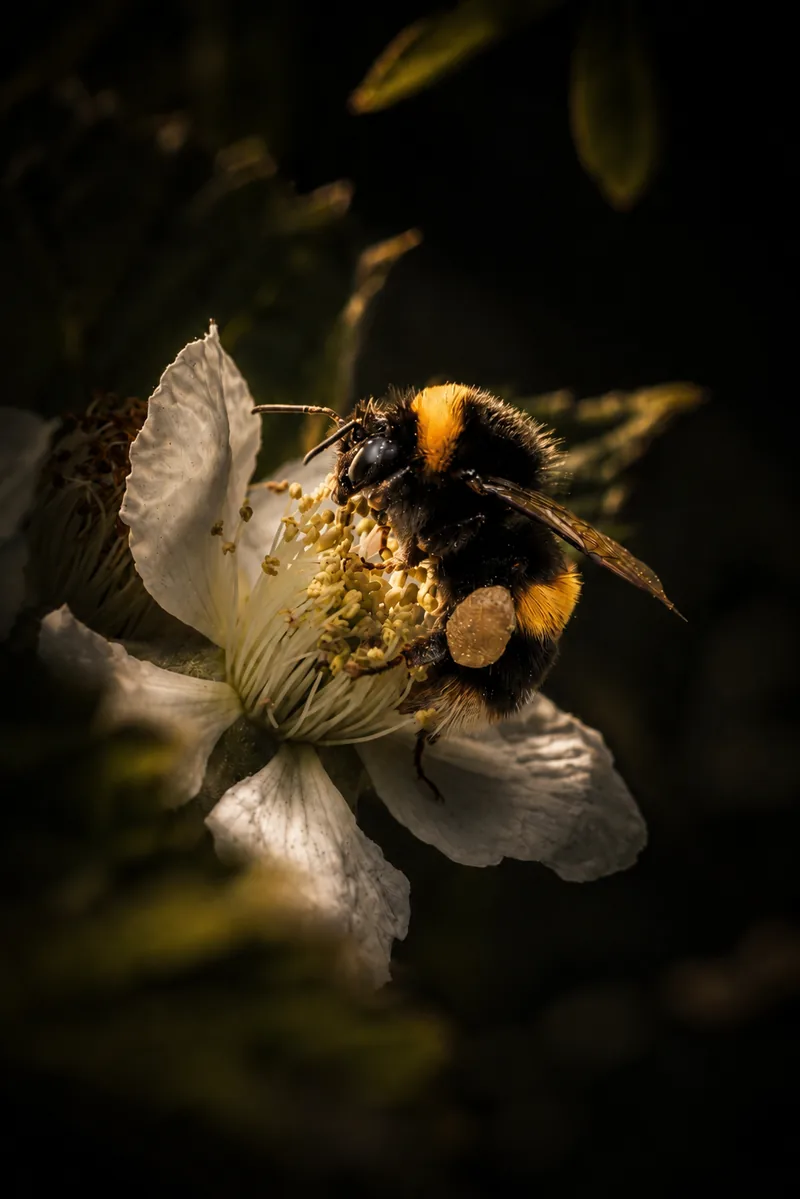
She flies with the same intent as her cousins — foraging hard, provisioning for whatever the colony needs that day. Her tongue is short, which suits her to the more generalist nectar providers — green alkanet among them. Watch her in harsh sunlight, which brings out the slightly less melanistic bands in her abdomen.
She is the tree bumblebee. Bombus hypnorum, though she rarely stands on ceremony about it. You'll know her by colour before you know her name: a thorax like a digestive biscuit, a black abdomen, a tail of pure white, as if she'd backed into a tin of paint. Of the British bumblebees, she may be the easiest to name on sight. No squinting required, no thumbing through a guidebook in the rain.
Turned up, uninvited, and stayed for tea
The strange part is how new she is. This bee was not here a generation ago. She wasn't recorded in Britain at all until 17 July 2001, near the village of Landford in Wiltshire — the first confirmed sighting of the species on these shores. Nobody sent an invitation. Nobody introduced her for a pollination trial or a curiosity garden. She simply flew over from continental Europe under her own power, liked what she found, and stayed.
Within twelve years she had reached the northern regions of Britain. By 2017 she was in Ireland. That is, by any reasonable measure, one of the quieter success stories in modern British wildlife — and it happened so gently that most of the country never noticed it happening at all.
She never asked us to build anything
Part of how she managed it so fast is that she never waited to be accommodated. Most bumblebees want a hole in the ground — an old mouse burrow, a gap beneath a hedge — and will spend days looking for one. The tree bumblebee, true to her name, would rather be up in the world: an old woodpecker hole, a gap in the eaves, a crack behind a barge board. Britain isn't especially well supplied with ancient, insect-riddled trees, but it has an enormous number of houses, so she has made do, with evident good humour, with whatever was already lying around. Bird boxes, mostly. Also loft insulation, compost heaps, and, because this is documented and not invented, the occasional tumble dryer vent. There are records of queens evicting blue tits mid-build to take the box for themselves — a piece of quiet, unbothered confidence most house-hunters could learn from. A most docile but beautiful synanthropic neighbour.
Her cousins — the buff-tailed queen doing laps of the clover — get the bulk of the sympathy, and they have earned it. But there is something almost British in the one bumblebee that turned up on her own, asked for nothing, and simply gets on with it. Virgil gave a whole book of the Georgics over to bees, and set their small labour beside the great forge of the Cyclopes without embarrassment — si parva licet componere magnis, if we may compare small things with great. He took their commonwealth as seriously as he took Rome; he would not have overlooked this one.
Queens wake as early as February, weather permitting, to found their nests alone — hopefully somewhere with willow catkins already out, or snowdrops, or crocuses, or whatever else is brave enough to be in flower that early. She works hard when the opportunity presents itself, and rarely gets annoyed by anything beyond a bit of door banging — which would have most of the country quietly tutting, too. If she nests near you, the kindest thing to do is simply leave her undisturbed. The colony rarely lasts beyond midsummer, and she never returns to reuse the exact nest — though the same doorway might tempt a different queen the following spring.
The cloud outside the box
None of this is the part people notice, though. The part people notice happens in May or June, when the box on the shed starts to hum, then buzz, then seem to boil — a knot of bees hanging in the air outside the entrance hole, thick enough to make you take a step back and reach for a number on the side of a van. It's a conversation that plays out in gardens up and down the country every early summer: a neighbour, quite convinced a wasp nest is about to become somebody's problem.
It isn't a wasp nest. It isn't, really, an attack of any kind. It's known, rather sweetly, as nest surveillance — a courtship queue. Males gather outside the entrance, waiting for a young queen to emerge so they might be the one to mate with her. That is the whole plot. The males doing all the dramatic hovering don't even have a sting; they are physically incapable of hurting anyone. The fuss generally settles by early summer, on its own, without anybody's intervention.
Still there in July
She will still be there in July, ginger and black and white-tailed, working what is left of the bramble flowers along the hedge, the foxgloves, and any lavender which has become available. Entirely unbothered by any of it.
She found a box nobody else wanted, made something of it, and never once needed us to notice.
We noticed anyway, eventually. Next time a bird box starts to hum in your own garden, that's worth remembering before you reach for the phone. Like regular houseguests, she remains proper and leaves in good time.
Cite this page: The Britographer — https://www.thebritographer.co.uk/journal/bumble-bee/tree/